Confessions of an Exorcist

15711334144_73d068e257_m
I remember being scared out of my mind when watching the 1973 horror classic, The Exorcist.  So I decided to interview Dr. David Appleby, who performs exorcisms.  Most exorcisms (or deliverances) are not like the movie.  Read his story below.

I interview Dr. David Appleby, founder and president of Spiritual Interventions, Inc., which is based in Lynchburg, VA.  Dave is also a graduate counseling professor and pastoral counselor.  He has been involved in the deliverance ministry for more than 35 years.

Heather’s note: Dave doesn’t see like a demon-slayer: he has warm and kind brown eyes and has a very fatherly way about him.  He’s also very soft-spoken.  But don’t let that fool you.  In addition to being super smart, well-educated, and possessing an impressive professional pedigree, he gets rid of things that literally go bump in the night.  People come from around the world to see him, after they’ve tried just about everything.  He then performs an exorcism (or deliverance, in evangelical Christian terms) on them, and their whole life changes for the better.  Below is his story:

Do you consider yourself an exorcist?

By definition an exorcist is one who is able to cast out demons or spirits.  It is usually a word associated with the Catholic tradition.  Protestants often use  the word deliverance, or deliverance ministry.   That would be me.

How in the world did you end up in this line of work?

When I was an associate pastor I was responsible for providing counseling services for my church.  I kept running into good solid Christian people who apparently weren’t able to overcome their problems when I used the standard psychological or spiritual protocols.  I knew that I was missing something so I went back into the Scriptures to look for indications of supernatural change.  I saw that change occur when demonic spirits were cast out.  Back in the 1980s there were no books explaining how to do deliverance available (though there were several who made a case for it) so I just started experimenting.  After 35+ years I’ve developed a methodology that seems to work consistently.  I got into the field because nothing else was helping my clients.

fullsizeoutput_2560
Dr. David Appleby has developed a model he has been using for 35 years to help people with demonic oppression.

Please describe your typical client?

Our clients are all Christians.  We won’t work with anyone who is not. Deliverance is for believers.  Why would one who has refused to be submitted to the Lord want, or hope to be set free from things when their whole attitude is in rebellion against the one who can provide their freedom?  Plus, if you remember the story from the Scriptures about the strong man and the stronger man.  When the house was cleaned out but not filled, the stronger man could come back with others that were seven times worse than the ones that were there to begin with.  Why would we do that to anyone?  Please see my book, It’s Only a Demon, for a more detailed explanation.

We see men and women, children and adults, professional people and not so professional people, the wealthy and the poor.  We see the physically and emotionally well and those who are not.  We see a huge range of clients.  The consistent factor is often that they have been damaged in some way, which in turn, opened the door to demonization.

What are some symptoms of spiritual oppression?

There are many.  First, feelings of shame or guilt that don’t resolve, accusatory voices in the mind that won’t stop, ungodly coping mechanisms (such as cutting, binge drinking, drug use) that just make the situation worse, difficulty making connections with people and with God, recurring nightmares or thoughts that disrupt sleep, and sins that don’t yield to traditional spiritual disciplines like meditation, prayer, fasting.

Some of this will be psychologically based, some physiologically based, and some spiritually based.

Here are a few more: a feeling that your life is not your own and that something else is working against you, personal or family problems that don’t respond to therapy, physical or psychological problems that don’t respond to medication, and finally, an inability to really, truly change.

How do you specifically make the demons leave the person? 

I don’t have the authority to make anything leave anyone.  As believers, however, we have all been given the authority by our Savior to command these things to leave in the name of Jesus.  When we do that in faith, and stand firm, they go, not because they want to, but because they have to.  Sometimes, however, we have to address the situations where these things gained access to the client before we can move forward.  It is only through the name of Jesus Christ (and his power) that a client can be set free.  While he is fully human, he is also the Son of God.  He created everything that is, including Satan and his demonic kingdom.  He defeated death when he died on the cross and rose from the dead.  In him we find life and supernatural authority over demonic spirits.

So you’re telling me that some Christians are under the influence of demons.  How does this happen?

Oppression is a non-biblical term that believers have decided to us to describe some level of demonic involvement that keeps the demon outside of the believer.  If you don’t believe that a believer can be demonized you have to have some explanation of what is taking place in the person.  Saying that the person is oppressed keeps the demon on the outside so you don’t have to deal with the theological issues.  The common doorways are generational (coming down through family lines), occult involvement (such as Ouiji boards, divination, witchcraft, sorcery, false religions, Masonic involvement in the family, drug use), trauma and victimization (physical, emotional, sexual, and verbal abuse, abandonment or betrayal by parents or loved ones, etc.), and long-term sin (a commitment to disobedience).

So there are four doorways for demonic oppression.  What is the most common one you’ve seen?

Trauma and victimization is the most common.  We are constantly astonished how many children are traumatized by their families and sexually assaulted by friends and family members.  When a person finds himself/herself traumatized, victimized, and isolated, with no support from the people who are supposed to care for them, they can become prey for the Enemy.

What are some of the strangest things that you’ve ever seen during your sessions?

Physically I have seen people act like spiders and try to climb up a wall, writhing on the ground, screaming, changes in voice and mannerism, etc.  Just a variety of weird stuff.

Can you elaborate on this a bit more?  I know there was a young man you mentioned in your book where it took you several men to pin him down.  Can you give at least one more example of odd/crazy behavior?

One time I was speaking at a conference where I normally do a public deliverance at the end of the training.  Actually seeing what takes place during a deliverance helps to normalize the experience for those observing.  It also normally makes people more comfortable with the thought of them joining a team and participating in the ministry.

In any case, in preparation for the conference, I asked the host to find someone who was willing to have a public deliverance.   The host was such a believer and had such confidence in God’s ability to deliver people that he went out and found the worst client that he could find.  What I did not realize at the time was that my client was about 6’ 4”, weighed about 300 lbs., and had a long history of mental illness.  He had also just been released from a mental hospital that morning.  He had also not attended the conference, nor was he a Christian.  I had no idea about any of this.  I try not to work with openly mentally-ill people in public settings as it often leads to a whole other level of complexity that is not helpful in a teaching setting.

In any case, all the attendees were sitting in rows behind me while I was sitting in a chair facing him.  He was an enormous, powerful man.  The first part of the deliverance went well.  When I addressed the demon, however, things deteriorated rapidly.  Suddenly he stood up, put his face about four inches from mine and began roaring, I mean screaming with a power and volume that was new to me.  I could feel his breath and spittle on my face.  After he got finished roaring at me he stood up, still screaming, and moved to the back of the room, where he started picking up and tossing chairs and tables around.  I sat in my chair without moving silently praying, “Lord, big angels, big angels.  Lord, big angels.”   Eventually he calmed down and told the host that he had to leave as he had to go to work.  He walked out the door.

The observers, who were sitting behind me, didn’t say a word the whole time as they sat there in total shock.  Needless to say, there were not many people who were interested in joining me in the deliverance ministry after that.  🙂

Another time, my team and I were working with a young woman who was suffering from Dissociative Identity Disorder (Sometimes what appear to be alters are actually demonic spirits.  Other times they are legitimate alters; parts of a fragmented personality.)  In the midst of this deliverance I excused myself to go to the bathroom while a colleague continued working with her.  When I came back into the room I recognized that something unexpected had happened.  In the midst of the deliverance the main personality, with whom we were working, disappeared and a pure demonic spirit took its place. It was not fettered by the presence of a human personality.  As soon as I walked into the room it recognized me and began to speak to me.  As it spoke every hair on my body stood up as an overwhelming sense of evil and terror filled the room.  It then went on to suggest all kinds of sexual things that I could do to myself.  It was a little unsettling.  In any case, we went ahead and removed this spirit and several others.  When we finished, our client was completely healed and never again had any episodes of dissociation.  In this case, what appeared to be alters were actually demonic spirits.  That is not always the case.

I hesitate to mention these extreme examples, as they tend to reinforce the Hollywood stereotype of what deliverance looks like.  Events such as mentioned above almost never occur.  I can count on the fingers of one hand the number of times such incidences occur out of literally thousands of deliverances.  When these manifestations begin to occur I just tell them to shut up and sit down and they do.  We have authority.

Have you ever been afraid during or after a deliverance session?

Rarely, mainly startled, because sometimes the unexpected can happen pretty quickly.   Plus, I do have big angels (I am told).

Have you ever encountered a demon you could not cast out?

I have discovered that I cannot cast a demon out of someone who wants to keep it or who refuses to submit themselves to the Lord.  I can’t help that person.  I have encountered situations where I was unable to figure out what needed to be done in order to cast the demonic spirit out so we were not successful.  Over the years we have, by God’s grace, become more discerning and have seen more success.  We now just assume that the demonic spirits will be gone by the time we get finished working.  That regularly proves to be true.

Can you tell me, briefly, about principalities?

These creatures, along with powers, thrones, and rulers, are mentioned in only a few places in the Scriptures ( Rom. 8:38; Eph. 3:10, 6:12; Col. 1:16, 2:15, and Tit. 3:1).  Not much is said about them.  I believe (and this is just my opinion) is that they are the same creatures that are referred to as Celestial Beings in 2 Peter 2:10 and Jude 8.  They appear to be demons or angels of a higher order that are often responsible for overseeing specific territories or have specific responsibilities.  Sometimes they find their way into people.  We are able to help people remove them.

Does your ministry do anything else such as clearing out peoples houses of ghosts, or other paranormal activities?

Sure.  I do that on occasion, as people request.  When I do, the manifestations stop.

What are ghosts, and do you believe in them?

The Bible is really unclear about it so I leave the question open.  When the Witch of Endor called up Samuel at Saul’s request it was apparently really Samuel.  Would he have been a ghost? Probably.  That is the only place in the whole Scripture where such activity is recorded.  I suspect that most of what people encounter aren’t ghosts, but familiar spirits acting like ghosts.

We’ve all seen movies with Catholic priests reading from the Bible, using holy water, and symbols like the crucifix. How is what you do similar or different compared to this? 

Sometimes we will read the Scriptures, sometimes anoint with oil, sometimes lay hands on the person.  I’ve not used holy water or the crucifix, but others have with some success.  Bless them.  We try to do nothing unless we are directed to do so by the Holy Spirit.

What is the actual deliverance process like, and who is typically on your team?

Not generally dramatic.  Quiet.  Intense.  Fun.  Lasting about three to four hours.  Successful.  My team consists of men and women, some in their 20s and some in their 70s, all of whom love the Lord and are delighted to have found a place where their unique spiritual gifts can be respected and utilized.  Each one blesses the other.  It’s wonderful.  Please see the book for more detail.

Is the devil real? 

I think so.  It is hard to look around the world and not see the fruit of evil surrounding us.  If you believe in good, it is hard not to believe in evil.  Whether or not that good is personalized as God or the evil as Satan is a matter of opinion.  Since the Holy Spirit is the one who convicts of sin, I don’t spend much time trying to convince others one way or the other.  I am too busy seeing people be set free.  🙂

What does it mean to be possessed?

Bad word, as it springs from a bad translation of the Greek in the KJV of the Bible.  Better translation would be demonized (which says nothing about ownership), which means being under the control or influence of a demonic spirit.

Do you believe in angels? Have you ever seen any of them?

Yes, I believe in them. I’ve never seen an angel, but I have been aware when they have been around. Sometimes I can feel their presence. Those who can see them tell me that they are often around me.  I need all the “air” support that I can get.  🙂

How does someone know that they may be spiritually oppressed and in need of deliverance?  In other words, advice for someone out there reading this who thinks they may need some extra help in this area?

Lots of times these folks wrestle with guilt, blame, and shame that will not go away, in spite of the fact that they know that they have been forgiven by God.  They find themselves tormented with no relief even though they are doing all the normal things that most churches teach should help to relieve such things such as more Bible reading, more prayer, more fasting, more worship, more church attendance, more small group participation or even, in the most desperate situation, working in the church nursery.  Most churches believe that the remedy to such torment is simply more.  The trouble is that that doesn’t fix the problem because these disciplines aren’t designed to address the issue of demonic spirits.  Only deliverance can do that.

Can you tell me about the gift of the seer? How does that gift manifest? Have your seers seen angels and/or demons?  

Sure.  Seers are people who are wired to see spiritual things, as did many people mentioned in the Scriptures.  Most of them have this gift from childhood but find it repressed by parents and churches who have no category for one who can see into the spiritual.  Parents will keep telling the child that they didn’t really see anything; it was just their imagination.  Those who are so gifted rarely tell others about this for fear of being seen as strange.

When such people join me in my work it is often like God suddenly opens a door and they find themselves seeing all kinds of things that they’ve never seen before.  Some have impressions.  Some see things in their mind’s eye.  Others see things as clearly outside of themselves as clearly as you and I see people.  We value these gifted people, affirm them, and train them to use their gift, particularly in deliverance settings.  They bring a very unique flavor to deliverance sessions.  Some can see demons.  Some see angels.  Some see both.

What are some of the positive changes the clients tell you about post deliverance?

A man with whom we worked a few weeks ago sent me an email.  This is what he said happened to him:

  • I must say that there is much that is different since we met. It has taken a couple of weeks to come to clarity and take shape. Let me describe what I feel is different.
  • I don’t hear the noise of condemnation constantly in my head. And when I feel something threatening it is much easier to redirect.
  • I feel at peace more often than not. I routinely sleep in when I want to instead of waking up to anxiety way earlier than I should be.
  • I don’t feel powerless. Even when I don’t do something I want to do I don’t relentlessly beat myself up. I am much better able to create and implement a plan than I have in years without feelings of pressure and hopelessness to perform. I have developed several plans and have actually followed through. Who knew 😊.
  • I do not feel a profound sense of incompetence.  I feel much more like other people.
  • When people ask how I am doing I more often spontaneously say ‘great’ – I never used to say that – ever.
  • I do not feel a profound weight of hopelessness around my spouse like I have for these few years, though this is still a matter of prayer.
  • I experience myself as uniquely gifted by God. Several have told me recently that I am anointed and I am actually experiencing that in a humble way.

Other common experiences include the removal of voices, fear disappears, there is more peace.  Even if nothing overtly can be reported, everyone will say that they feel more peace than they have ever had.  It’s all good.

Can you tell me an example of a client where the deliverance was not successful?  Why was it not successful?

Sorry, but I can’t.  I can think of people who have walked away from deliverance because they decided that they wanted to keep their demons because it gave them a sense of power that they didn’t want to lose.  I can think of people who stopped the process because they had, in infancy, been so traumatized that the demonic spirit had so closely identified with the human personality that they didn’t know where they ended and the demon began.  As we removed the demonic spirits the person became more and more fearful as they felt like they were losing themselves.  The demon that they knew was less threatening to them than the freedom that they had never experienced.

Have demons ever come after you personally because of your line of work?

Sure.  I am a target.  After 35+ years of doing this I suspect that somebody from the other side knows my name.  I’ve been impacted personally and professionally.  Of course, the Lord has always used if for the good.  Sometimes I’ve found myself demonized as a result of trauma, or personal sin.  Sometimes the Lord has delivered me spontaneously. Sometimes I’ve had to call my team to help me. Fortunately that doesn’t happen a lot.  I’ve always viewed what I do as like being in a boat.  As the water gets deeper the boat floats. As  long as you stay in the boat it doesn’t matter how deep the water is.

What is the biggest misconception about the devil?

That if you leave him alone, he will leave you alone.

In your view, what is the Devil’s primary role in someone’s life?  

His desire is to destroy everything that God loves because he hates God so much.  God loves you and he loves me.

What is the biggest misconception about God?

That he isn’t good.  That he doesn’t love us.  That he wants to punish us.  That we can’t trust him.

What have you learned about God through your participation in this ministry?

He is more loving, forgiving, accepting, and powerful than anything that I can conceive.  The Enemy has already been defeated.  God has chosen to use his children to set other children free.  That is so cool.

Second to last question.  What would you say to readers who would not yet consider themselves a Christian? What evidence can you give to them that points to a loving God?

You don’t know what you are missing.  The fact that all of creation has been created for our pleasure and that we are surrounded by a God who loves us and gave his Son over to death that we might experience all these good things.  After all, he is love.

Finally — If you could sum up your entire ministry in one sentence — What would it be? 

My six year old granddaughter was trying to explain to a friend on the school bus what it is that her grandfather does.  She said, “My grandpa is a doctor who takes bad dreams out of people’s lives.”  Love it.  🙂

_____________________________________________

P.S. from Heather, in bullet format, because bullets are fun:

  • I have been fascinated with the Dark Side since high school and used to read a lot of books about the occult and watch a lot of horror movies. I’ve always wanted to interview someone who has direct contact with the spirit world — so here you go peeps!  I hope you enjoyed it.
  • I have my own demon story to share, and will do so in a later post.
  • I am always hyper sensitive to people’s reactions when I post a blog.  First of all, not everything that people experience is demonic oppression.  Problems and issues can be physical, psychological, mental-health, emotional,  chemical, or spiritual (demonic) in nature.  Or, more likely, a combination thereof.
  • I also don’t want people to think that only Christians can be oppressed by demons.  That is far from the truth.  Everyone certainly can, from every walk of life.  Christians are able to be set free from Satan and demons, however.
  • Deliverance is a ministry that can help some people.  If you think you need help, or have further questions, please contact Dave directly at: dappleby@spiritualinterventions.org.  His website is www.spiritualinterventions.org.  His book is “It’s Only A Demon.”  You can find it on Amazon for $16 bucks — however there are only a few left, as it’s being replaced by his new book.  Fair warning, the cover of his book is creepy and weird.  The book itself is super interesting.  He also just released a new book called “Transformative Encounters” which will be available shortly.
  • Thanks for reading!!

The Choice That Saved My Life — (my birthday story)

My mom — pregnant with me. She wasn’t allowed/invited to graduate with the rest of her Senior class because of her ‘situation.’

It was the winter of 1972, and my mother Linda, a beautiful 17 year-old girl with long black hair and green eyes, was set to graduate Salutatorian of her senior class in just a few short months. Because she had already completed the credits necessary to graduate, she was able to finish her senior year in January, but was still planning to officially graduate with her fellow classmates and even give her Salutatory speech in the spring.

Linda had the whole world at her feet: a great family, a handsome and great boyfriend (Mark) whom she’d been with for nearly three years, college in the fall, and great friends.  Until one day when her whole world changed.

That day came when her period, which she was expecting for some time, never came.  She had heard that  Planned Parenthood, located downtown, offered free pregnancy tests, so she nervously drove to their facility.   Once there, she took the pregnancy test, which confirmed her fears:

She was pregnant.

Not only did Planned Parenthood offer free pregnancy tests, they also offered counseling.  She met with the counselor who told my mom that, due to her young age and because she was still in high school, that she should get an abortion.  The counselor also explained that although abortion was illegal in most of the U.S., it was legal in New York state, and that my mom should consider this option.  My mom left the clinic that day with her head buzzing with questions and her heart pounding with anxiety.

What to do?

Back in early 1972, getting pregnant in high school was extremely rare.  And there was certainly an element of shame and embarrassment that went with it. After telling her boyfriend Mark about her pregnancy, they both decided that they would like to keep the baby and possibly get married.  But first, they had to work out an opportunity to confess to her parents that she was pregnant. She knew that her parents would be distressed by the news, as their family was a moral, church-going family.  Although they were clearly taken aback by this disclosure, the only comment was made by Linda’s father was this:

“Nothing like this has ever happened in my family!”

After Linda revealed the news, her parents decided to go to their Presbyterian Minister for counsel and support.  Linda’s mother, Inge, was also this Pastor’s secretary, so it was easy to set up an appointment with him.  A few days later they met with their pastor and told him of their daughter’s pregnancy.  They asked him what they thought her daughter should do, and what advice they (as her parents) should give to their daughter.

After hearing their story, their pastor told them: “Linda is young, and she is very smart.  She should go to college.”

He paused for effect:

“In my opinion, she should get an abortion.”

My grandparents were shocked at his advice, coming from someone they considered a religious leader. Abortion was something that was only heard about in whispers, and no one they knew had ever had one.  My grandparents strongly disagreed with his advice, and went home confused and frustrated.  After my mom talked further with her parents, they all decided that it would be best that she should not seek an abortion, but rather that she would get married to Mark, set her college education on hold, and have that baby, even though her whole future lay ahead of her.

The spring rolled around and my mom was not even invited to her own high school graduation, or to give her speech.

Then one hot summer day my now 18 year old mom, her new husband, and her parents, all checked into the local hospital in Syracuse, New York, and eventually delivered a healthy, blond-haired baby girl weighing 9 pounds and 4 ounces.   They named her Heather Lee.

That baby girl was me.

IMG_4718

I can’t say it was easy for my mom to have a baby at 18. She proceeded to have another baby (my sister) two years later, but it was a difficult marriage, and my parents divorced a few years later.  She was able to squeeze in a one year degree to be a Medical Secretary, and she indeed pursued that career for many years as a single working mom.  It was very hard during some portions of my childhood for each of us.  Years later, my mom remarried and had two more kids, and now she is working as a nurse.  Things all eventually turned out really well, and through it all she never regretted her choice to have me, and neither have I.  🙂 To read more about some of the struggles my mom (and I) went through, click here.

As for me, I grew up, got my undergraduate degree, then my Masters, had a wonderful career, met an awesome man, got married, and become the mom of three great kids, with one adoption on the way.  In a strange twist of fate I ended up working for a leading pro-life Senator, working on pro-life policy.  (You can read about it here).

In another interesting twist, I actually had a chance to talk to that same pastor (who recommended my abortion) several years ago. I basically told him that my grandmother (his former secretary) had recently passed away, and then transitioned to tell him that I disagreed very strongly with his very sharty advice he gave to my mom and grandparents many years ago.  (Actually, I was very kind and just told him respectfully that I disagreed with him, and that I was very happy to be alive.) We got into a weird debate/argument on the phone and he told me that “abortion is God’s will because it can naturally happen anyway,” (in other words, a miscarriage) and other things I won’t go into here. I honestly wasn’t looking for an argument, I just wanted to state my case.  I guess somewhere deep inside of me I wanted him to apologize to me.  To say something like “wow, I”m so sorry for the advice I gave to your mom’s parents, because, duh, if they had listened to me, we wouldn’t even be having this conversation right now.  I am so freaking sorry about what I said and did.  Can you ever possibly forgive me?”  But he didn’t.  I think he felt defensive, so he was somewhat curt with me.  The call didn’t give me the closure I was looking for, but I felt he needed to hear from me, as one of his Pastoral Advice Survivors.

I wonder how many kiddos are not here because lots of good Presbyterians listened to their Pastor during his 30 year tenure.

Sometimes I wonder what life would be like if my mom had made a different choice.  Would Erik even get married?  He is a super picky guy.  One of his friends said he was like an oil-change service, with an 18 point check- list of what he needed/wanted in a future girlfriend or wife.  What about Claire?  Who would have adopted her?  And Logan, we almost didn’t even get him in the first place.  What if he was being raised by his birth-father right now? His birth-father who has a criminal record, by the way.  How would he turn out?  And what about Khloe?  I’m pretty sure she would still be stuck in a Ukrainian orphanage, just waiting to age out.  I don’t believe she would do well out on her own.  And those are just four people in my immediate circle.

I believe God has a purpose for each of us on the face of the earth. We are here not just for ourselves, but to help and serve and to love other people.  Every human life matters and every human life is meant to interconnect with other human lives!  We all need each other. Maybe your story is supposed to intersect with mine, and vice versa.  And what we do makes a difference, even if we can’t see it.  Please read this post for more encouragement: Small Things with Great Love.

I will close with one final story.  Many years ago, Erik and I hiked up to the top of Mount Washington in New Hampshire.  I was about to turn 30 years young and was feeling “depressed” about “getting older.”  (HA.  Foolish person.)  Anyway, I was up on top of Mount Washington in the restaurant on top of the mountain, and my eyes wandered over to a list of people, mounted on the wall.  This is not an ordinary list: it’s a list of all the many people who have died up on Mount Washington.  This mountain is surprisingly very dangerous and is said to be the home to the “world’s worst weather” and has winds that have been recorded up to 231 miles per hour!  As I read through the list, I noticed something specific:

I noticed the ages of all the people who died. Their ages were varied: fifteen, eighteen, ten, twenty, twenty-five.

So many young people had lost their livesSo many young people who died on the mountain who never reached their 30th birthday.

That was a reality check for me.  Ever since seeing that list, I am grateful, rather than depressed, whenever I hit another birthday milestone.

In closing, I am so very glad my mom chose to have me despite the sacrifice and difficulty that choice brought into her life.  And I’m glad this story had a happy ending (as I know that not all stories like this do).  And I just have to add, as I get older and older myself, I absolutely LOVE having such a young and healthy mom.  She is a volunteer firefighter, full time nurse, and she and my step dad run a homestead.  She is a super busy and active grandma. As for my dad — he is still going strong and healthy.  He retired from full-time work but still works part-time.  He is a wonderful grandpa and makes his family a priority.  It’s great to have such young parents.

So mom, if you are reading this post, thanks for bringing me into this world and giving me a chance at this thing called life. I am super happy to be here!  I love you!

Happy Birthday to me!

P.S. from Heather: I know abortion is the most controversial issue of our day, and lots of people have strong opinions on either side, and lots of women have experienced abortion.  My intention is not to judge, cause hurt or pain in someone else, to make someone angry, for you to unfriend me on Facebook, or for you to send me a scathing text.  My intention is to share my own story as it pertains to this difficult topic.  Perhaps it can help someone out there, or plant a seed.  It is not my intention to cause division. And remember, this is only a story…my own story.  Finally, I welcome all comments!!  Even comments that have a different perspective.  But I just ask that we all respect each other as we comment.  Thank you for reading.

P.S. from my mom: Even though I was so young at the time, and I did not come to have a personal relationship with Jesus until several years later, I was still able to recognize the unfairness of depriving my baby a chance at life so that I could go on with my own life undisturbed. The choice I made did lead to hardships and difficulties that I would not have experienced otherwise, but I feel that these problems were used by God to develop my character and also to make me see my need of Him.  So I am grateful that I gave the gift of life to Heather!  As are Erik, Claire, Logan, Khloe as well as her many friends and extended family members.  It is heartbreaking to me to think of how many relationships have been lost to abortion, and that is part of the reason why I have been involved in pro-life work ever since I became a Christian.  Thank you for reading our story.

One more P.S. from Heather: I just published my first book! 

The book is about Christian deliverance, and how to reduce demonic activity in people and places. I share the struggles of what led me to seek out a deliverance for myself, how a friend and I started our own deliverance ministry, and what I learned about creative ways to do basic spiritual warfare to reduce demonic activity in people and places. I discuss the many negative symptoms of demonic oppression and the four doorways (trauma, occult involvement, ongoing sin, and generational curses), and teach everyday Christians how to command demons to leave people and places, in Jesus’s name. If you are struggling with demonic oppression, a haunted house, or other demonic activity and you’re not sure how to handle it, check out this book!

The link is here: https://a.co/d/4kDlJwH

Blowing Stuff up with an EOD

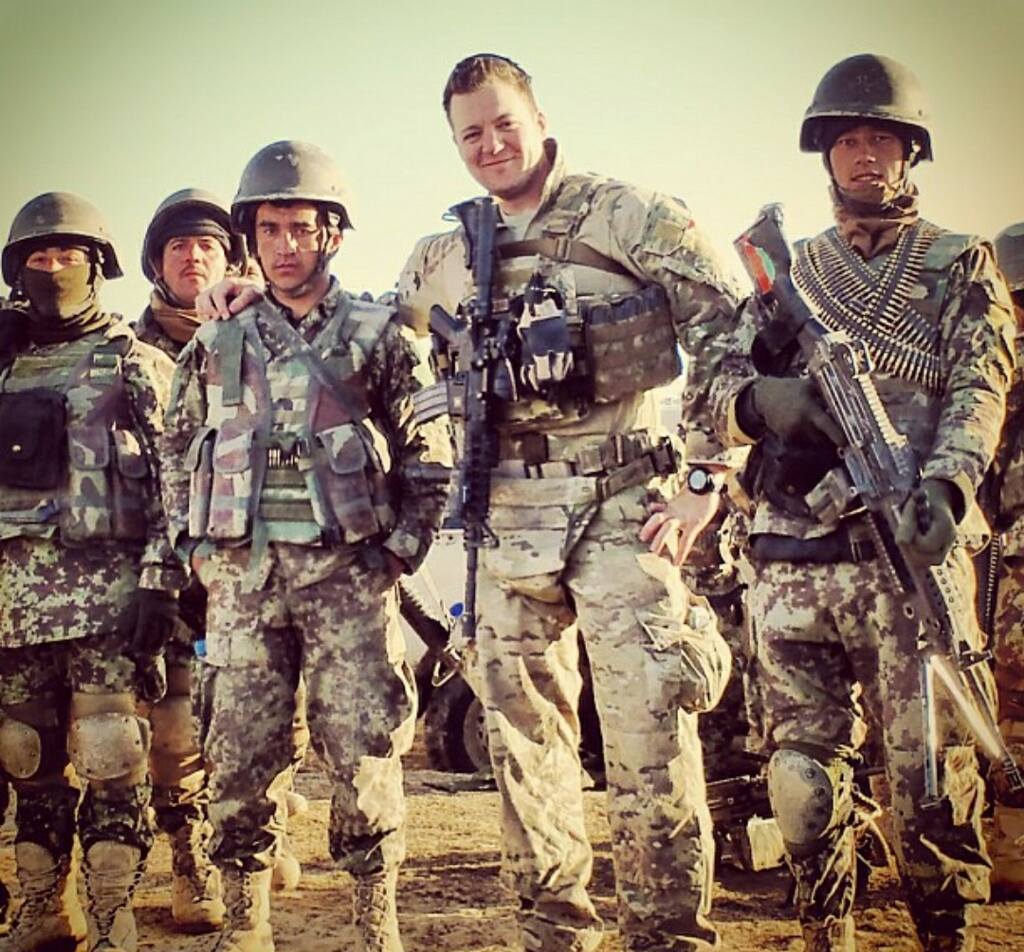
I interviewed Paul, who was an EOD with the Air Force.  He dismantled IEDs (home-made bombs), blew stuff up, protected the President, completed top secret missions, and kept people safe.  Below is his story. 

When Claire was just a little baby, she was in foster care for three and a half months.  After we adopted Claire, we became great friends with her foster family, and still have a relationship with them to this day. One of their sons, Paul, was already in the Air Force at the time of Claire’s adoption, working as an EOD Technician. (EOD stands for Explosive Ordnance Disposal.) Claire’s foster mom Robin would often email me and request prayer for Paul, because he was often in very dangerous situations.  I am finally interviewing Paul to figure out exactly what he did for a living. Paul is now retired from the Air Force (even though he’s fairly young) and I had the opportunity to do a Skype interview with him.

IMG_4632
Paul (center), with Afghan soldiers.  Paul was retired as an EOD Tech after 16 years of service in the Air Force.  It’s a small miracle that he even survived. Below is his story.


IMG_4706
Paul and Claire, being silly.

First of all Paul, tell us about your job?

EOD stands for Explosive Ordnance Disposal, basically disarming anything that was ever created since the beginning of time from any country, whether chemical weapon, biological weapon, nuclear weapon, hand grenades, or IEDs.  We deal with them all.  And then, where appropriate, detonating the bomb.  We deal with anything that goes boom or zoom.  We also do range clearances and also Secret Service detail for the President.

(quick research note: according to Airforce.com, an EOD Tech is “trained to detect, disarm, detonate, and dispose of explosive threats all over the world…assigned to some of the most dangerous missions.  They do what needs to be done to keep others safe.”)

Why did you choose to go into EOD?

I wanted something more, and that was definitely it.  If you google the most dangerous job in the military across all the branches, it’s number one.  We all go to the same school — the Navy, Air Force, Marines, Army — we all attend an EOD School on an Air Force base in Florida that’s run by the Navy, but all of us are in the exact same school, even mixed in the same class.  I went in for the action, the adventure, and to blow stuff up.  What little boy doesn’t love that?

What was training like?

Training was very difficult.  We started with 100 people and we graduated with 7.  EOD has an extremely high wash-out rate.  You have to be able to do a very high-intensity job with zero errors.  And you have to be able to do it in a 90 pound bomb suit when it’s 115 degrees outside.  You have to be able to function well while you are exhausted.  All of our studying was done through books and publications.  All the studying had to be done at the classroom for up to fourteen, fifteen hours a day.  Because it’s classified, you couldn’t bring anything home.  And you do that for nine months straight, and that’s just for the basic course.  You will continue years of additional school and a lifetime of training.

Are there any women that go into EOD?

Yes, there are.  A lot of women don’t make it through the pull-up part of the test. But there are females that do it and many of them are actually really good bomb techs.

How long were your deployments?

Six months to a year for a deployment.  Some don’t deploy for awhile and some deploy back to back. I left Iraq because Bush told us we were pulling troops out of Iraq and everyone cheered, but then I got shipped straight to Afghanistan.

What do you actually do in the field?  Sounds like you dismantle bombs and then blow things up?

Yes, we try to disarm them first, where they are at. Usually, the bomb is in a bad spot, we disarm it enough to where it’s safe for transport and then we bring it out to the middle of nowhere and dispose of it.  We blow it up.  We try to get the intel part we can keep first.  We also do range clearances, which is essentially where we clean up bombs that don’t go off at military training sites, especially in Nevada.  We also dispose of things for the Military (by explosives).

OLYMPUS DIGITAL CAMERA
Paul, on one of his deployments.

Have you ever disarmed a bomb that you weren’t quite sure how to properly disarm?

Yeah, all of them, kinda.  A bomb that is dropped from an aircraft, all are pretty much the same and there are publications and books to deal with this, step-by-step.  With an IED (which stands for an Improvised Explosive Device), which is a home-made bomb, it’s different, as they are all slightly different.  But that’s the challenge – to figure it out.  That’s why I like it so much.  How does it function?  How does it work? And then figure out the safe way to disarm it.

Were you afraid to die?

For me — the reality of what just happened or what you just had to do never really hits me until after.  Even afterwards, when you are heading back to camp, you are still on the “mission high” and you really don’t think about all the “what ifs” and what could go wrong.  Thinking about ANYTHING else but the problem in front of you will get you killed.

Where did you serve?

Texas, Mississippi, Colorado, Florida, Europe, California, Nevada, then deployments: Iraq, Afghanistan, and other places (top secret).

Tell us about your Presidential Detail?

We are the bomb squad for the President, so wherever he goes, we go.  We get there long before he does.  We also provide service detail for Foreign dignitaries, First Ladies, Vice Presidents, U.N. Counsels, anything where there will be big people at, where there could be a threat, we work with that.  I was face to face with President Obama once; we both nodded at each other.

Tell me about a typical mission?

When you are deployed, you get a call, most of the time it’s a group, maybe a convoy somewhere, that came across an IED and they set up a safety circle and evacuate everyone out of that area. And they call us and say, “hey, we need an EOD for an IED.”  At that point, we either convoy or fly out to that location.  We also bring a whole security convoy. We go out to the location and deal with it.

Tell me about one of your more memorable missions?

That’s a hard one.  There are so many and I don’t know how to categorize.  There are some missions that you will never forget; they leave a scar on your heart.  There are some where you get a good feeling.  For example, once we took an IED out of a school.  They try to blow up their own schools with their own kids in them.  Another time, there was a magnetic IED that was stuck to the side of a fuel tanker. In front of hundreds of other fuel tankers, all side by side.  Had that gone wrong…

Most dangerous mission?

Night missions are always some of the most challenging and dangerous missions.  But a lot of work is done under the cover of darkness, at night.  Other dangerous missions are when you are going after the bomb maker; their homes are well guarded by the products they make.  But I have to say that the most dangerous missions I did as an EOD Tech are the ones we are not allowed to talk about.

Your mom told me that she prayed constantly for you.  Was there a time where you know for sure your mom’s prayers for your safety were answered?

Yes, there were at least three times that I remember.  First, before I was an EOD I was a Firefighter in the military.  One night we got called to a building to put out a fire.  The building had ammunition in it which we had no idea about.  While I was in the building the ammunition started going off, so  I was immediately pulled out of the fire. When I got out they checked my jacket and sure enough, there was a bullet lodged in my jacket, through my clothing, but somehow, miraculously, had not penetrated my final layer of clothing — it hadn’t pierced through my chest.  However, my jacket did end up with so many holes in the front and back that I had to replace the jacket the next day. Come to find out, my mom had been up all night, unable to sleep, with a huge burden on her heart to pray for me.  Everytime she’d fall asleep, the Lord would wake her up again to pray for me.

Another time I was in Iraq and was afforded the opportunity to Skype with my mother.  During the Skype call we had a rocket attack.  One of the rockets exploded close to the area I was in.  The “wood building” I was inside (that was really more of a shack), had sustained massive damage.  I was blown to the floor and the shack was full of holes going in one side and out the other.  I got up, a bit shocked with ears ringing and a massive headache, but I was alive with no real injuries.  The moment the rocket hit, all Internet was killed.  The last thing my mother heard was the sirens warning of incoming rocket attack, and then everything went black.  A few days later I went back to that same shack; it was closed off due to damages but I went inside anyway.  I sat there scratching my head asking myself over and over again: “How did none of that hit me?”  There is no way I should’ve survived that.  Come to find out, my mom had been praying.

Lastly, one time we went out on a post-blast analysis, after there’s been an explosion somewhere.  We go out there and determine what type of explosive was used, how it was detonated, are there any more, gather intel, look for patterns, and make the area safe for other personnel to get in and do their job. The enemy knows this and will sometimes use that to lure us into a trap.  The enemy waits for us to arrive because they want to take us (the EOD) out because we are a high-value target to them.  There were a couple of times when I got to the scene that I got this weird feeling — the hair on the back of my neck stood up; it didn’t feel right.  To this day I can’t tell you what it was that was “off.”  But it’s listening to that inner voice, not just hearing it, but doing something about it, is what keeps you alive.  I had great fellow EOD team members with me whom I also trusted with my life.  When they didn’t like the way something was being done, or had a bad feeling about something, we would switch things up.  We wanted to keep the enemy constantly guessing at what we would do next.  I know my mom’s prayers were heard and answered on some of these particular missions as well.

IMG_4707
Aunt Robin, and Claire.  They are so cute together.

What did you love about your job?

I love traveling.  I love blowing things up.  It’s a lot of fun, like fireworks, but so much better; you are so close it just rocks your world. And then seeing the dust and everything flying up around you. I also enjoy the camaraderie.  I used to be a Firefighter in the military– EOD is similar to that but even stronger.  And you truly made a difference.  When someone steps on an IED on the ground, if there is one IED, there will be more, it’s like a land mine.  You gotta run to the front, sweep up, but that guy is screaming and you have to get to him.  To make a difference and do all of that, it’s a gratifying feeling.

I absolutely loved my job and I miss it.  I wish I could still do it.

Even though it was so much pressure, stress and danger?

Absolutely.  They only want people in this career field who absolutely love it.  If you ever decide that EOD is not the job for you, they will immediately cross train you into another position in the military.  Again, they only want people who love their job.  And you have to be of the right mind to work in this job.  If your wife just left you, they will pull you off the field, so you don’t make a mistake. Everyone you’re working with loves their job and wants to do well at their jobs. Plus you get extra money for it.

What is the mortality rate of an EOD?  It seems pretty high.

I don’t know.  I know the injury rate is really high.  I know for our class we started with 100, we graduated seven (the rest washed out).  Of those seven, three are now dead.  And two of us are out.  There are other ones that keep working longer. The EOD motto of “Initial Success or Total Failure” could not be more true.

Was the movie The Hurt Locker an accurate portrayal of the life of an EOD?

The movie is great for showing you an idea of what we do while deployed and a rough idea of what the life of an EOD Tech is like.  However, this is a lot of Hollywood added.

What did you dislike about your job?

I had some long deployments.  I was never married, so it was a lot easier for me, but that’s why I never married.  I chose not to because of that.  There was a woman I was dating, she was in the military, she said she would refuse to date me if I went EOD, because she had lost too many friends who were EOD.  She said she wasn’t going to lose a husband.  I can respect that.

Why did you stop working?

I was medically retired early from the military, due to injuries sustained while I was deployed, mostly due to TBIs (traumatic brain injuries).  Some of it was due to explosions, being too close, things that hit me in the head, anything and everything that wasn’t supposed to happen, did.  I had 19 TBI concussions and 13 knock-outs.  So I had to retire.

What is the number one piece of advice to give anyone going into EOD?

First is, you gotta know you want it.  Because when you’re sitting there in school, for hours and hours, and you’ve been studying your brains out and chugging five hour energy to stay awake, you have to know you really want it.  But it’s very rewarding.  It’s a brotherhood much like the Fire Department but stronger and tighter.  That leads to my second point, you cannot do this job without your team.  You have to work as a team — period.  And you’ll be deployed a lot which is really hard on families. EOD stands for “Every-One’s-Divorced,” — due to the amount and length of deployments.

What are you doing now?

I am converting a Mercedes Sprinter Van into a custom RV so I can travel the country.  I’ve cut out a lot of people in my life that just waste my time.  I want to spend my life with, and my time with, the people I love.  So right now that’s my girlfriend, and her son.  I’m working on getting my health back.  You only have so much time, so I want to spend it with the people I love.

Has it been an easy or hard transition?

It’s actually weird and difficult.  I joined the military right out of high school, and I was always told what to do.  So now I still feel like that kid right out of high school again.  I don’t know where I want to go or what I want to do.  I have the financial means and the time, which is even better, but at the same time I’m like “I don’t know what I want to do or where I want to go.” And also, the civilian world is different.  There is less of that sense of camaraderie and brotherhood.

Describe your EOD job in one sentence?  

It was a blast!

_______________________________________________

A quick note from Heather:  Sadly, most EODs end up six feet under.  Maybe not most, but many.  That fact that Paul survived is a small miracle.  I credit that both to Paul being an outstanding EOD Tech, but also to Robin, Paul’s mom, who prayed for him constantly.  It really is true that when it’s your time, it’s your time.  And when it’s not, it’s not.  Grateful that Paul is still with us to share these stories! And….I hope he gets married someday because he’s a great guy!  I’m glad he’s part of our extended family and we wish him the best as he gets to have a second chance at the rest of his life!

To watch a video of Paul blowing stuff up, click here:


IMG_4708
I wish Paul all the best as he enjoys the first day of the rest of his life!  Thank you so much for your outstanding service!


Blue Collar Girl Trapped in a White Collar Marriage

I want to take you back to the 1970s and 80s and reminisce about what it was like to grow up somewhere on the spectrum between poor and blue-collar in upstate New York, where I grew up.  Back to the days when it was common to see a 1971 Plymouth Baracuda cruising down the streets of Syracuse, windows open, driven around by a guy in a dark blue uniform with a name-tag, blasting “Free Bird” or “Stairway to Heaven.” Maybe there’s a cigarette dangling from his dirty/greasy hands, hands that are hard to get completely clean.

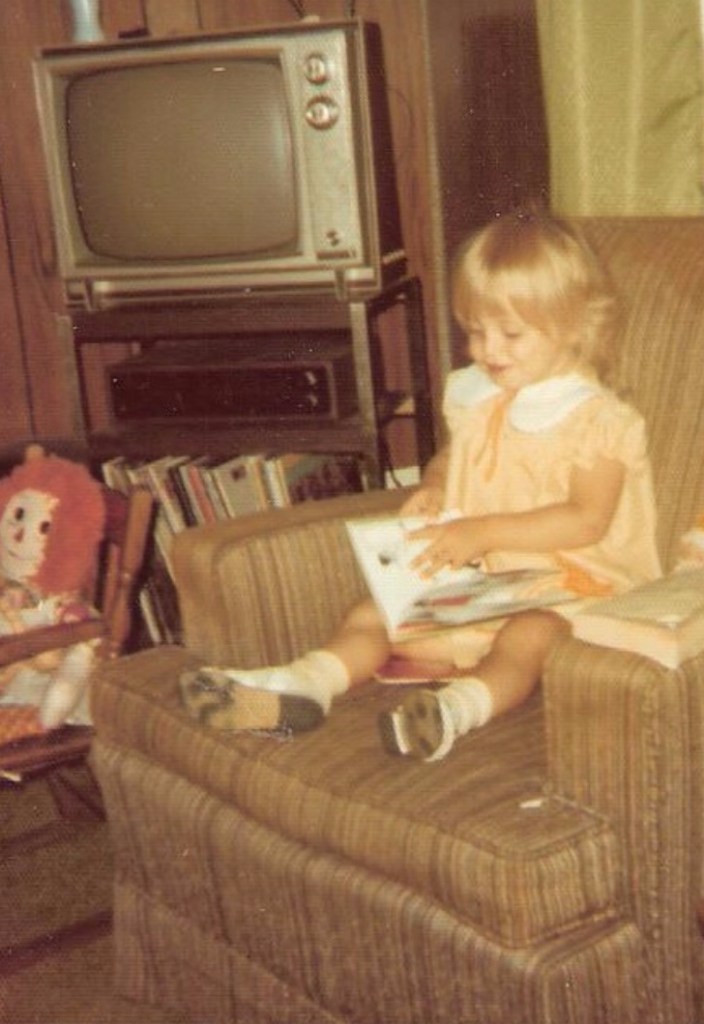
Maybe there’s a little blonde-haired girl in the back seat with him, looking out the window, hoping the smoke will stop blowing into her face.

IMG_4629
Me, as a young girl.

That little girl was me, and I want to share with you my perspective of what it was like to grow up in a blue collar single-parent family — both the good and the bad— and what I have learned since then.  I will also share how I have changed (or not) since transitioning to a white collar marriage several years ago.

Here is my super quick back-story:

I grew up the child of a single working mom after my parents’ divorce at the age of four.  My dad worked at a local car manufacturing company and we didn’t see him very much because he was always working (overtime, double-time, and other terms his union negotiated for him), and did not consistently seek out a relationship with my sister and me. There were also some dysfunctional elements of my childhood in the mix as well.  My single mom was poor, and we (my sister, mom, and me) survived on her small secretary’s salary.  Child support was very low back then so I always noticed how hard she struggled.  Our small family of three drove around in a brown pinto and didn’t go out to eat much because we couldn’t “afford it.” On hot summer days, we would beg my mom to stop at Arctic Isle (the local ice cream stand) for a $1.00 soft serve ice cream cone and the answer was always “no, it’s too expensive, we have ice cream in the freezer at home.” My mom was very cheap and often said no to buying almost anything that wasn’t a necessary item.

Not having a lot of money growing up made me take a good, hard look around me and make some serious inner vows. Vows such as:

“I will work really hard, go to school, and make good money so I won’t have to struggle.”

“I will marry an awesome guy and we will NOT get a divorce.”

“And if don’t get married, fine.  I will do really well in my career.”

“I will show everyone that I am not a loser and will make something of myself.”  (Not sure exactly where that one came from, but I think it stemmed from some deep-seeded self-confidence issues.)

With those inner vows in the back of my mind, I started babysitting at 11, worked my way through high school and college (clocking in between 20 and 30 hours per week as a waitress during college), and then landed a professional job in my early 20’s.  I eventually got married and ended up in what I call a white-collar marriage. On a side note, I was also very picky about the guys I dated, making sure I wouldn’t end up with a “creep,” a “perv,” or a “loser.”  Bottom line?  I didn’t go on many dates.

Below is just a portion of the more difficult aspects of growing up in the poor/blue collar income bracket. Perhaps you can relate to some of these?

  • …First, I remember all the CIGARETTE SMOKE.  Smoke in the house.  Smoke in the car.  Smoke in a tree.  (How can that be?) I have so many memories of just sitting in front of a various TVs that sat perched on the green living room carpet, watching maybe Star Trek, Evel Knievel, or Scooby Doo while someone smoked behind me in an easy chair, reading a newspaper. Growing up in a smoke cloud gave me (subconscious) permission to begin smoking myself very part-time through high school and college.  I finally quit in my early 20s.

fullsizeoutput_1ae3
I am a proud survivor of years of second hand smoke.  I began smoking part-time in high school but quit in my early 20s.

  • …We MOVED a lot.  I have many fond/not so fond memories of various apartment buildings, houses we shared with other friends, and yes….I even spent some time in the coveted trailer park.  I will never, ever forget how tiny those little trailer bedrooms were, and the trailer closets were ridiculous.  On an up note, I was able to share a house (different units) with my best friend Hillary, who was also in a single-parent home, which was awesome. We also lived in the same apartment building a couple of times.
  • …We had NO MONEY.  I heard “we can’t afford that” about 1000 times.  Want to stop at McDonalds?  Nope, not gonna happen.  If you want money, you had to get your butt off the couch and go earn it, all by yourself.  So that’s exactly what I did. I have never stopped working and to be honest, it’s so strange for me to not work in a way that earns an income to this day (more on that later). I am still so grateful that my grandparents were so generous with my sister and me — they provided everything from new Trapper Keepers for back to school (remember those?), to new clothes and shoes, to very generous Christmas gifts.
  • …As mentioned above, I didn’t see much of my DAD. Early in life, I developed some father-figure issues and ended up crushing a lot of older men, and men in positions of authority over me. However, I did appreciate his hard work ethic.  He even built our house from scratch and much later, my mom moved back into it and still lives there to this day. We now have a great relationship (as adults), but again, he wasn’t around much growing up and that was hard for me.
  • ….Finally, I struggled with some TOUGH EMOTIONS.  I often felt ashamed of my clothes, house, and cars.  I felt insecure and unworthy of love.  I feared rejection.  There were some things that happened that caused some deep wounds, that I have (thankfully) since healed from.  But they were very hard to go through at the time.

fullsizeoutput_21fb
Yes, friends, that is a beer in my hand 🙂

But growing up blue-collar was also a blessing in many ways.  Here are just a few of the positive elements of growing up in a blue-collar family:

  • First and foremost, I developed an amazing WORK ETHIC.  I have no problem with doing “real work,” “physical work,” and “working with my hands.”  Because my grandfather was in the farming business (he built silos) and also we lived near a farm, I actually have helped neighborhood kids with their farm chores.  I have also actually picked the following: rocks in a huge farm pasture/field, tomato horn worms off of tomato plants,  and weeds from my mom’s garden.  I mowed the lawn consistently (when not living in apartment complexes). In fact, I still happily mow my own yard here in Suburbia while my neighbors watch me curiously from their windows.  Bottom line?  I am not lazy and I’m not afraid of real work.
  • Secondly, I KEEP IT REAL with no BS.  You will always get the real deal from me. I will always shoot 100 percent straight with you.  I don’t like to lie; it makes me uncomfortable.  The only lie I will tell you is if you ask me directly if you look fat in that dress, and if you do, I will feel bad, and I will lie and say no.  You have been warned.  But that’s about the only lie I feel okay about.  Sorry not sorry.
  • Thirdly, I will never be pretentious. I will never think I’m better than you.  I will always treat everyone THE SAME.  And I will always be generous.  I will always over-tip waiters and waitresses, and I will always say “hi” and “thank you” to all the people who make my life easier.  Why would I be snooty with waitresses and maids?  I actually did both of those jobs for many years to earn a living.  Those are my peeps.

IMG_4628
Having fun at one of the restaurants (the Ground Round) I worked at during college.  I sometimes clocked up to 30 hours per week waitressing during school.  Growing up blue collar gave me a kick-butt work ethic.

  • Lastly, I developed an appreciation for the CLASSICS, and no I’m not talking about classical music or classical home-schooling eduction.  I’m talking about Classic cars and classic rock, baby.  Whenever I go back to Syracuse I still see folks driving around in a classic car blasting classic rock.  I just went to one the Eagles’ final concerts last summer before their lead singer passed away.  It was a blast!  (see photo below.)

    IMG_1089
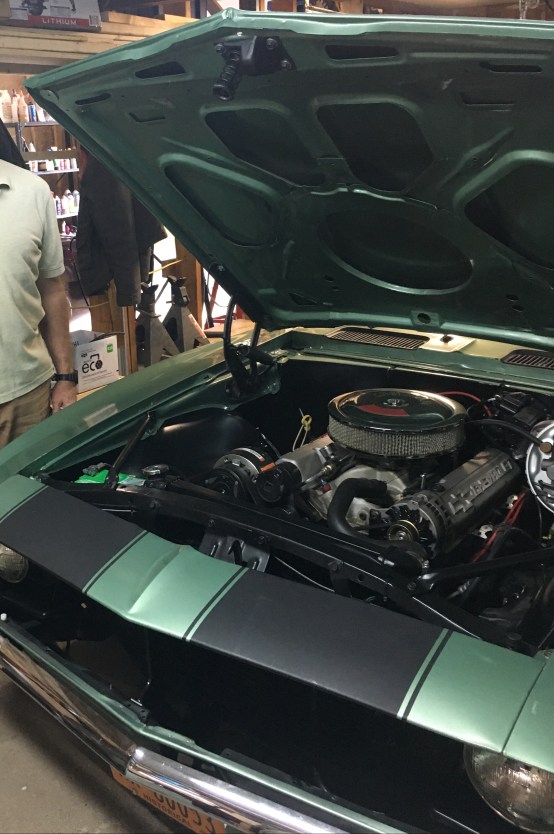
    My dad owns five classic (muscle) cars purchased in the last ten years.  These were the cars I grew up around.  I want one.

IMG_1090
His Plymouth Baracuda.  My appreciation for classic cars came from my dad.

So what have I learned since “moving on up” to a different income level?

First, I actually really appreciate money and where it came from.  It is a blessing to actually have some of it.  But here’s the deal: I never want to rely too heavily on money or grow accustomed to being upper middle class.  Why?  Because I developed a deep financial insecurity early on. I know deep in my heart that you can have money one moment, but then the next moment…POOF! It’s gone.  And then you are back to square one. So I decided to not even leave square one in the first place.

Secondly, I am still cheap (especially with myself) and don’t like to spend money.  I still clip coupons (if I feel like it, because coupons are really a pain), and try to limit my children’s material possessions so they don’t become “spoiled.”

Thirdly, I still feel weird about not working outside the home in a way that generates an income. I still feel a little bit like a “moocher” even though my husband assures me he is fine with me being a stay at home parent.  I do plan to work again when my kids are older and after our next adoption, but I would prefer to work part time.

And on that note, I think that’s one of the best things money will buy you: options.  I have the option of working part-time rather than full-time down the road. Our family has the option of spending our money on nice vacations (we have created memories for our kids and have taken them to some nice places). We have the option of buying my kids sneakers exactly when they need them, rather than waiting until the next paycheck comes in.

fullsizeoutput_2ca
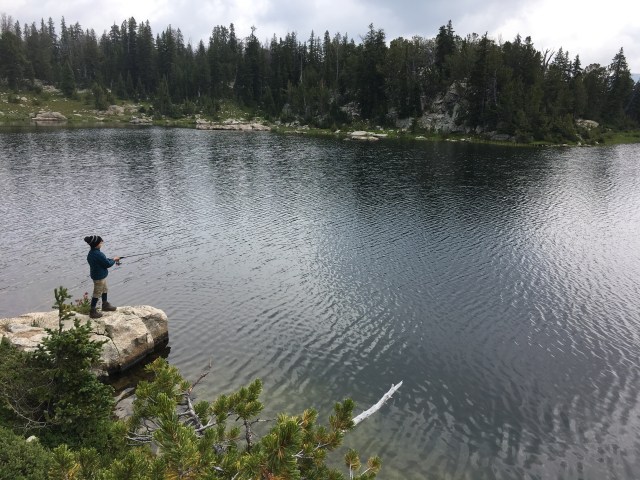
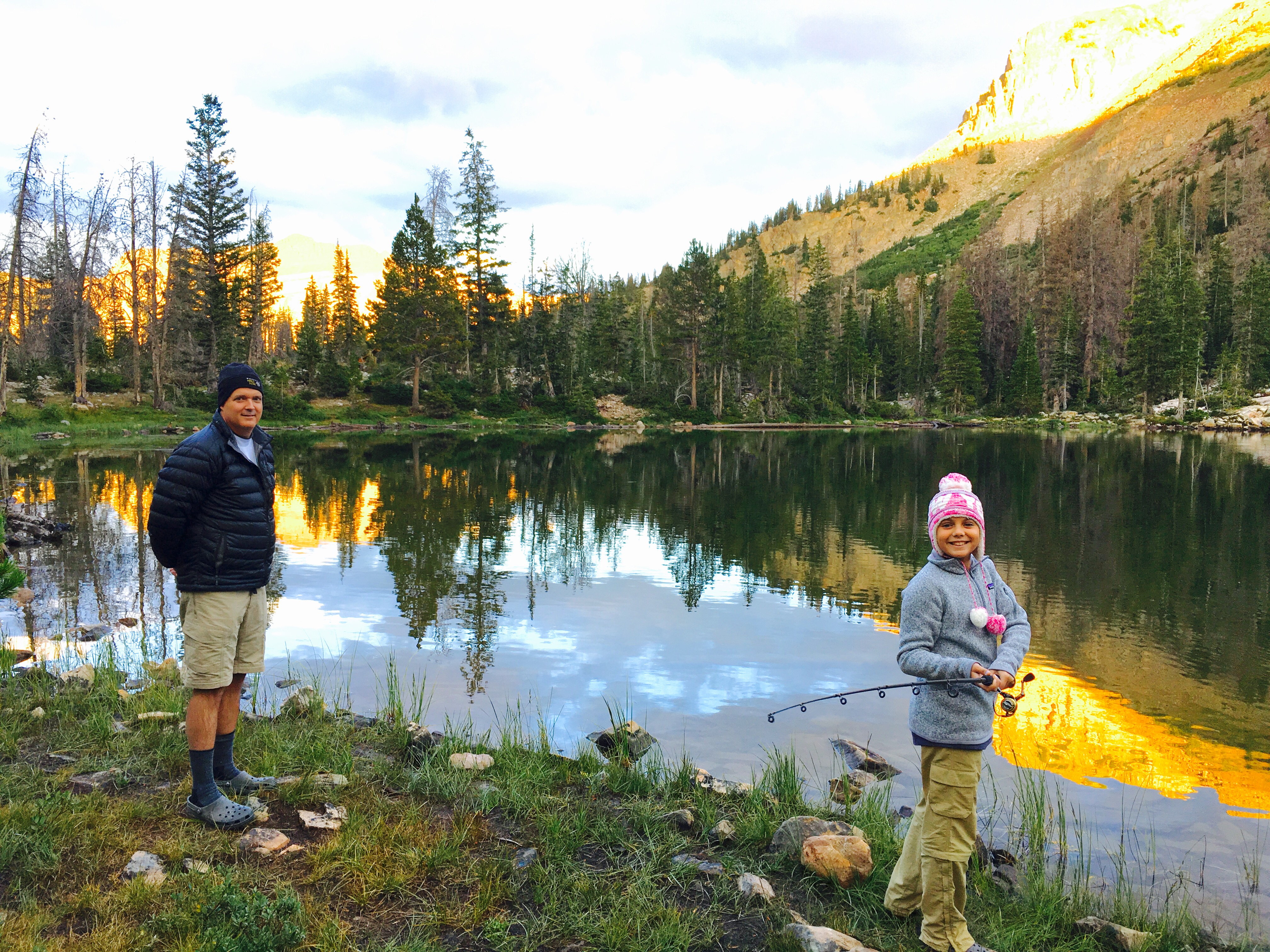
There is one thing money can buy: precious time with your family!  We do spend money on making memories with our kids, for sure.  Above, Claire and Erik enjoy fishing in a back-country lake in Utah.

Fourthly, I have learned that money doesn’t buy happiness or inner peace.  However, it does buy time and convenience.  It’s either time or money.  Either you spend the time on something and save the money, or spend the money on something and get back some of your time.  So in that way, it’s a lot easier to exist in a white-collar world.

Finally, the number one reason I believe God has blessed us with a little bit of extra income is a. because God is good and He just chooses to bless us in this particular way, b. we both worked very hard to get here, c. to afford to adopt our children, because adoption is expensive, and d. so we can be generous with other people, and also with ministries and other worthy causes that need financial assistance.

Bottom line?  I believe money is a gift to help support and enhance human relationships and to support worthy causes.  If you have money, chances are, God wants you to help others in need.

So why did I choose the title of this blog?  Honestly, I’m not really “trapped”in a white-collar marriage per se, but I feel as though I really don’t belong some elements of this world, deep down.  One night we spent time with another couple who are also in our income bracket.  Both the husband and wife were very cultured and came from solid families, and they had lived all over the world.  Both of them had PhDs from prestigious universities.  As they shared about their childhoods and current successful careers, I felt like I just couldn’t relate to them.  I felt like I had to impress them with something about my life, but I just couldn’t think of anything to say.  I also didn’t feel like I could be completely myself around them.  (Qualifier: most white-collar folks are super, duper nice and not pretentious at all. Maybe they’re a lot like me and didn’t grow up that way. But if they did grow up with wealth, they seem to have a certain self-confidence about them that poor kids lack.  I think I sense this subconsciously and feel I cannot relate.)

In closing, Oprah Winfrey once said that obtaining money just makes you MORE of something.  So if you are kind, you become more kind.  If you are generous, you become more generous.  If you are an arse, you become more of an arse.  I agree with her assessment.

Since transitioning income brackets I have become the following:

More cheap (with myself)

More generous with others

More unpretentious

More hard working 

More efficient with my time 

More grateful for money, but knowing it’s limitations

I am grateful to be where I am today, but I will never forget where I came from.  My childhood made me into the person I am today, and I am grateful for all the lessons it taught me.  Blue-collar workers truly do make the world go round, and I am proud to be counted among them.

So if you see a suburban woman driving around a really nice convertible, blasting the Eagles, drinking coffee from a coffee mug from home because she didn’t want to stop at Starbucks because it’s too expensive, all the while thinking about how she needs to mow her lawn when she gets home, well…that would be me.

I’m teetering between the two worlds, not really fitting into either one at this point.

But that’s ok, because that old saying is true:

The more things change, the more they stay the same.

So while I may be in a white-collar marriage, I’ll always be the same blue-collar girl, deep inside.

Peace out.

img_7603.jpg
Off to the Eagles concert with my dear friend Ragan!

_________________________________

PS: Stay tuned for a future post: Raising Blue Collar Kids in a White Collar family.

Thanks for reading!!

Top Ten Decorating Tips

IMG_4448
We love our new rustic wood-pallet wall. We hung up an industrial-style clock to mix things up.  Don’t be afraid to mix styles as long as it all blends well together at the end.

I have been happily married for 17 years and have been decorating our home on and off ever since.  After years of flipping through magazines, going over to my friends’ homes and stealing ideas, watching HGTV like everyone else, and just plain wandering through furniture stores and cruising around on-line, I have finally figured out my own decorating style and picked up a lot of solid decorating tips over the years.  I want to share them with you today.

But first, no…I don’t think I’m the most fabulous decorator in town.  I have made many mistakes along the way and I still have a lot to learn. Secondly, there is nothing in this post that is rocket science, just things I have learned over the years.

So without further delay, here are my top ten decorating tips, in order. I will start from the beginning, in case you suck at, errr….are new to, decorating.

Tip #1 Declutter your home and get rid of your old college furniture

If you do not declutter, no matter how awesomely decorated your house looks, it will look BAD because it will look CLUTTERED.   I am not talking about “normal family clutter.”  We all have that.  I am talking about serious clutter.  Get rid of it or find a home for it.  Also, if you have old furniture from your grandma or your college days and you don’t think it’s up to snuff and it’s from around 1985, get rid of it.  (If you can’t afford new furniture, see my P.S. where I give you a couple of ideas of how to decorate inexpensively.) Once your home is relatively free of old stuff and clutter, we can move on to decorating…. woo hoo

Tip #2 Decide your decorating style 

The first question I need to ask you is: which side are you on?  Classic or Eclectic?  Let me explain. Classic decorators include traditional, transitional, country, coastal, antique, etc.  If you are eclectic, perhaps you lean towards modern, vintage, or industrial, or even something crazy like art-deco.  Or perhaps you are somewhere in between.  I visited a friend last year in California and she decorated her home in the style of mid-century modern and I loved it!!  But I have no clue how to decorate like that.  So you first need to decide your style.

Click here for ideas to get started:

www.hgtv.com/design/decorating/design-101/design-styles-defined-pictures

My suggestion?  If you are not sure what to do, choose something more traditional or classic, and add different decor elements from a different style or styles.  My personal decorating style is traditional/classic with rustic, vintage, and industrial touches.

Tip #3 Decide on, and purchase, your big ticket items first 

Choose your furniture and larger items first and foremost.  Make sure they all blend together well.  Beware of darker furniture, because in the light of a furniture store what may look a beautiful wine/brown leather color actually looks black when you bring it home (I know this from experience).  If you have have young kiddos, consider a darker leather couch, or washable fabric with a guarantee of some sort.  Bottom line: get your furniture and rugs (or wood floors) down first before you get all crazy with the smaller stuff.  Or the smaller stuff won’t blend in.

Tip #4 Choose your paint colors carefully.  And “pop color” on a ceiling or a door

I cannot tell you how many paint mistakes I have made.  We once bought what I thought was a beautiful light orange color and painted our entire living room with it.  Once the paint was up, it looked like human skin on a very pale white girl.  It was awful.  We had to repaint it immediately.  Another time I surprised Erik by painting our master bathroom really cool, light “sea foam blue” color.  The only problem?  After it was up it changed into mint green.  That did not go over very well, and he made fun of me for about a year until we changed the color.

Paint color is magical and mystical.  It changes color once it leaves the store and is up on your wall.  It changes color throughout the day.  You will love it at 9 am and hate it at 6pm.  I am not kidding you.  The point?  Try to find a color you can live with/absolutely love 24 hours a day.  If in doubt, go neutral.  Grays, creams, and beiges are still lovely. If you are not sure which color to choose, yellows and blues are good go-to’s.  Beware of super dark colors.  Few homes can actually pull them off well because they are so dependent on natural light, which varies throughout the day.  Your super cool dark red accent wall will look like deep-dried blood around 9 pm.  I would avoid that if I were you.

My suggestion?  Paint you walls warmer colors and “pop a color” on your ceiling or door.  We painted our bedroom a cream color and the ceiling a very dark orange and I think it looks pretty freaking cool.  Our living and dining rooms we painted a cream color (interactive cream – Sherwin Williams) on the walls and then a lovely brown color (canoe- Sherwin Williams) on the ceilings. But make sure the two colors blend well together.  Ask the paint store for assistance in this.

IMG_4444
Paint colors: always tough to figure out.  We wanted a “warm” feeling in our dining room so we used cream for our walls, but then we “popped color” (brown) on our ceiling.

Tip #5 Put up a wood pallet wall or paint a fun color on an accent wall

We put up a wood-pallet wall and we LOVE it!  If you don’t like the wood-on-the-walls look, then paint one wall a different, accent color.  And then decorate it with cool, funky picture frames or other decor items.  Get creative.

*since wood-pallet walls are all the rage, I will put more detail on what we did specifically in my P.S.S. section.

Tip #6 Add smaller items and accent pieces 

After you have purchased the furniture and have chosen your paint colors, and perhaps painted or wooded-up an accent wall, now the fun begins.  Get online or go to stores and find pictures, decor and other items that “speak to you.”  There are so many good places to find inexpensive decor items.  I love the Home Goods Store.  You can try TJ Maxx, Target, Walmart, Michaels, and even K Mart.  You can go on-line wayfair.com.  There are SO many choices now.

My suggestion?  Have fun and get pieces from different decor styles but make sure it all blends together at the end.

Tip #7 Organize all of your family photos and kids art/brag stuff in one area of the house 

We put our updated family photos on our new wood pallet wall.  And all of my kids art work and certificates of achievement are placed in another smaller area.  I think it looks cluttered if your kid stuff and family photos are all over the house (my personal opinion).  Figure out where it looks best and put it all in one spot.

Tip #8 Pop color throughout the house

With every room, the rule is two basic colors and one “pop” color.  So, for my living room, my two colors are cream and brown (kinda boring) but I “popped” yellow in the book case as well as the curtains and pillows.  It looks better with one “pop” color.

IMG_4440
Two basic colors (cream and light brown) with one “pop” color — yellow

Tip #9 Decorate according to your own values

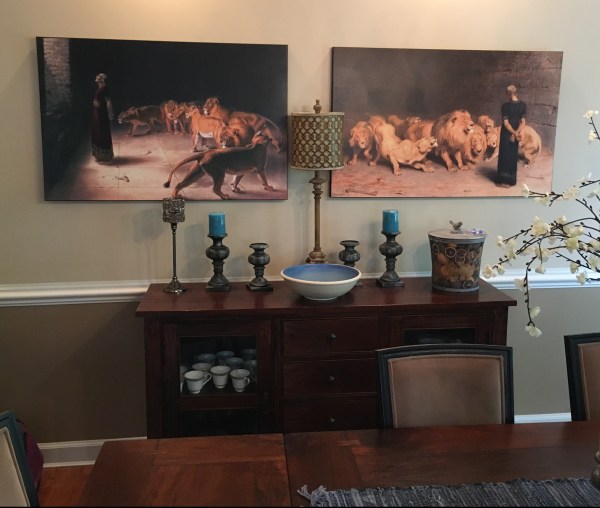
Decorate with meaningful pictures and art work that represents who you are. Like birds?  Decorate with bird art.  Huge fan of music? Purchase an old guitar and mount it on your wall.  Are you religious and want to have a conversation piece?  Pop some religious art.  We hung two really cool pics of “Daniel in the Lion’s Den” in our dining room; a before and after of sorts.  It makes for some great discussion with guests.  I have fun vintage signs in my kitchen which make people laugh and it starts conversations.

IMG_4441
Daniel in the Lion’s Den — a great conversation piece

Tip #10 Got kids?  Create a kid space

Kids are the number reason why houses get MESSY. Try to keep it all in one room of the house.  Do the best you can.  Keep all of your board games in a place you can easily see and access.  Keep all of the art stuff in one place too.

Bonus! Tip #11 Update your lighting fixtures

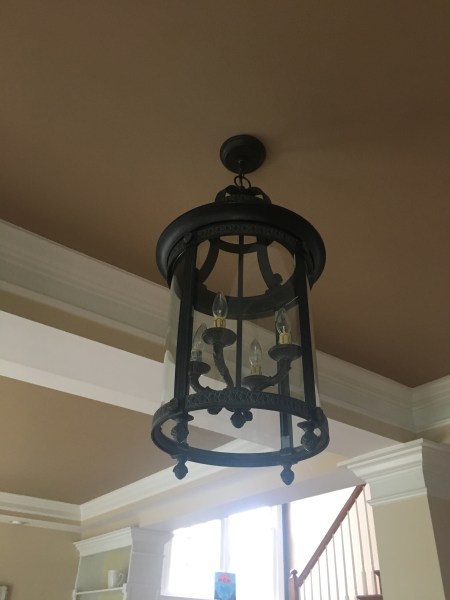
This one change will greatly affect how the inside of your home looks.  Take a look at your current dining room or kitchen table chandelier.  Does it cover the time span between 1965 and 2005??  If it does, please, for the love of all things, REPLACE it.  You can find some awesome, inexpensive light fixtures online (Amazon, Home Decorators, Wayfair) or at many home stores like Lowe’s and Home Depot.  What about your kitchen?  Does it have that huge fluorescent light in the middle of it?  Get rid of that son of a gun.  Install cool, fun, practical lighting all over your home.  Buy new table lamps with style and color.  Consider small hanging lights (like indoor Christmas lights, but not) in one room of the house (perhaps your kids space). Lighting can VASTLY change the mood of your home.

IMG_4458
One of the best things you can do is update your lighting fixtures!!  We found this one at home decorators.com

Bonus Tip #12 Steal (I mean, get….) ideas from your friends, and decorate slowly

I love visiting new homes and getting ideas from my friends.  Of course, I don’t completely copy them exactly, but I get new ideas.  You can also feel free to steal ideas from me.  And decorate incrementally!!  Don’t stress over how long it takes to get your home together.  It has taken me three and half years to beautify my current home and it’s still not completely decorated.  Take your time and try to enjoy it.

Bonus Tip #13 Remember why you decorate

Finally, remember the ultimate goal of having a nice home is that you have a comfortable space for yourself (if you are single) or for you and your family to enjoy and live together in peace and harmony.  Try not to obsess over your home (and decorating). Love PEOPLE more than you love things.  Things get old, dirty, and broken.  People are gifts from God.  This includes friends and neighbors, too.  Welcome them into your home and feed them some tasty food.  If you love your home and the way it looks, it will make you and your family happier, and you will be much more motived to throw some par-tays.

In conclusion, I hope this post helps get you motivated to replace some old lighting fixtures, tackle a wood-pallet wall, and paint over that dried-blood-red wall with something light, fresh, and pleasing to the eye.  But make sure you like your paint color at both 9 am and 9 pm.  🙂

What about you?  What are your best decorating tips?  Let’s all share and learn from each other!

_____________

P.S.: Here are just a couple of “cheap” decorating tips.  You can find quality, inexpensive paint at Lowe’s and Home Depot.  Choose paint colors carefully.  Paint first.  Got old couches and you can’t afford to purchase new pieces?  No worries.  Buy a couple of nice, cream, matching slipcovers that FIT WELL and then buy some really nice, colorful accent pillows to go in each corner of couches (or love seats).  Pier One has great accent pillows.  Got an 80s coffee table from your grandma?  Fine. Paint it and then distress it (google or youtube this.)  Put some books neatly on the coffee table and maybe a cool vase in the middle. You can find lots of decor items in clearance aisles in various stores and at Flea Markets.  Go to Michaels, buy some cheap frames, and then print off things you find on-line and then put the print in the frame (vintage maps, vintage birds, anything that doesn’t have a copyright).  You can even put your kids artwork in cheap frames.  Check on line deals; wayfair.com has daily deals of up to 70 percent off.  Watch that site like a hawk. Finally, google “cheap decorating tips” and you will find many ideas.

P.S.S: Our wood pallet wall: to make a long story very short, I was originally going to do “peel and stick wood.”  (Just google it.) But it was WAY too expensive and definitely a DIY project (you have to carefully, with a little saw, cut the sides off of pieces that are too long) so I hired a local guy who actually got real, reclaimed wood, stained it in about five different colors or shades of the same color, and then he put it up piece by piece, staggering the wood out in a way that looks cool.  It took him several days to get the wood ready and about two days to install it; the total was about $800.  You can totally DIY this project but it’s a pain as you have to a. Locate the wood b. Make sure the wood is the same size and very straight across the top c. Stain most of the wood in grays and browns (leave several pieces with no color however) and then d. Carefully put the wood up evenly in a staggered way with a nail gun.  That takes a lot of time.  Or you can pay someone, as we did.  If you live local, I will give you the contact information of the guy we hired if interested.  You can also do a wood wall much cheaper by using Lath strips of wood, found at Home Depot, which are about $12 per bundle.  You install them with a Brad Nailer.

Hope this helps!! Thanks for reading!

Venezuela in Crisis

18698582_10154654317252218_1194346669_oNo food, no medicine, babies left at hospitals, kidnappings, protesters dying, and complete government denial.  Maria shares her story.

A quick note from Heather:  About four months ago, I watched a news clip of a very attractive yet very skinny Venezuelan woman digging through the trash.  She explained to the news reporter that she was looking for food to feed her family.  I then contacted my friend who is from Venezuela (who now lives in the U.S.) and asked if this report was indeed true, and she said a resounding YES but that it was far worse than I could imagine.  She told me her mother in law (Maria) lives and works in Venezuela and could really fill me in.  So I sent Maria an email with several questions.  She wrote me the following letter in return:

Dear Heather,

Without a shadow of a doubt, Venezuela is in the middle of  a complete humanitarian crisis.  Please allow me a few moments to tell you what I see on a daily basis.

No food, no medicines, and even longer lines to obtain what little people can find.

People are dying on a daily basis due to lack of food and BASIC medical supplies. Hospitals and healthcare centers have collapsed due to the fact that there are no supplies in order to treat patients. Doctors have been arrested or reprimanded by the government for “smuggling” gauze, band aids, alcohol etc. in order to help treat patients. Add to these more serious cases, like cancer patients receiving chemotherapy or diabetic patients receiving dialysis treatments, and surviving deems nearly impossible.

There is also an immense  lack of staple foods and essential items (toilet paper, sanitary pads, deodorant, toothpaste, etc.).  The government has tried to subsidize these items but you must stand in very long lines (we are talking anywhere from 4 to 12 hours) in order to obtain them at a reasonable price. For those who can afford to pay prices that are 4 to 5 times their cost, they are limited to a certain quantity and you must present your identification every single time you make a purchase. It has been a way for the government to control and monitor your spending for years. And they still call this a democratic country.

The inflation rate has caused devastation throughout the nation.  A monthly minimum wage salary is 40,000 Bolivares (About 10 dollars) which can buy you practically nothing, so standing in extremely long lines is the ONLY option for most Venezuelans.

A study came out recently, that the average Venezuelan has lost 19 pounds. People call it the “Maduro diet.”  People are rummaging through the trash. Everyone is so thin. I can’t begin to imagine what it is like to raise a young family.

I need to tell you about the babies.  As a volunteer in a children’s hospital, I see how almost daily, mothers are leaving their babies because they are physically unable to feed their children (lack of proper nutrition for the mother; therefore little to no milk production) as well as financially (formula is liquid gold…too expensive). Mother’s resort to the last option, leaving them somewhere they feel can properly keep these infants and babies alive. Most are sent to nearby orphanages, which as you can imagine are already filled to capacity; with yet again very little to tend to these children. Some babies have died due to lack of nutrition.

Venezuela is very unsafe.  It’s not safe to walk the streets.  Business Insider ranked the top 50 most dangerous cities in the world; seven of them are in Venezuela. Caracas, our capital, is ranked 1st. However, the government has rarely released this data, and most know the numbers are far worse than the government claims.

Close friends of our family were kidnapped off the streets and held for ransom.  They call this the Secuestro Express.  This is where gangs target upper class citizens whose families are able to pay ransoms quickly and quietly.

Things are completely out of control.  

There is no freedom of speech, no freedom of the press, no freedom to protest peacefully as the constitution states. There is no democracy.

The people of Venezuela have been protesting out on the streets for the past 50 + days. This is a constitutional right, but from that first massive protest, the national guard has acted out violently against protesters. More than 50 deaths have been reported, mostly young students who are in the front of these marches.  These young people, the future of our nation, protest wearing white shirts on their backs with their hands raised, yet this is the threat the government chooses to silence.  These young adults who were born into this administration, but knowing that there has to be a bigger and better future for them, choose to stand up and resist this regime. These 16, 17 and 18 year old young adults are our fallen heroes.

Those who speak out against the government will be sought out and punished and for the case of many, they have been silenced.  Passports have been seized and many people (at this point, those in dissent) are not able to leave the country.  I am worried that soon it could be even worse for regular citizens who wish to leave.

Maduro is an illegitimate president. A dictator to a once fruitful nation. Alongside Chavez, he has destroyed our nation and left it in RUINS!

I have a few thoughts on what people can do to help.

First, you need to know that this a spiritual battle. There is EVIL residing in our land, no doubt about it. Only through prayer and fasting will these demons come out. To those who can, please pray, please fast, please spread the word.

There are many organizations that help.  We recommend cuatroporvenezuela.org.  This organization provides food, basic medical supplies, and much needed medicines to the people of Venezuela.  

Thank you for your interest in our story and the plight of the Venezuelan people.

May God bless you,

Maria

P.S. from Heather: This blog post is my attempt to help. If you are willing and able, please consider making a donation to the website I listed above.  No amount is too small.  And FEEL FREE to share this post.  And above all, please PRAY as Maria directed.  God bless you all, and may God save the people of Venezuela.

Below: protestors attacked by the Venezuelan military.

18676831_10154654314087218_233321630_o

Below: doctor pleads with the National Guard to stop harming the young students.  Moments later he was hosed down. (see photo at top of post).  All photo credits go to the people who posted them on Instagram.

18697832_10154654300582218_862639832_o

Small Things with Great Love

mother'sday2017

Me (above) — working behind the scenes to impact my kids for good.  And my kids — who appreciate me one day a year.  Happy Mother’s Day!

Several years ago, a well-known Christian Pastor resigned his post as Senior Pastor of a large church, and moved to Asia in order to serve God in a more behind-the-scenes way.  Francis Chan was quoted as saying:

“I don’t believe God wants our church life to be centered on buildings and services.  Instead, God wants our churches to be focused on active discipleship, mission, and the pursuit of unity.”  He also added: “I think there has been too much emphasis on me.  Even in my own church I heard the words “Francis Chan” more than I heard the words “Holy Spirit,” he said.*

It got me thinking about why someone would give up their position in the spotlight to serve within the shadows?  In our society, there is such a distinction between the hero and the individual; those in the spotlight and those whose roles are more behind-the- scenes.  We tend to subconsciously elevate the rock star, the leader, the politician, the athlete, the movie star, or (for some of us) the well-known pastor.

I call these people the “one percenters.”  About one percent of the human population seems to influence the rest of us “99 percenters,” for better or for worse. These are the people with platforms, followers (social media and otherwise), and cheering fans.  I think it’s sometimes easy to think that those in a position of leadership are the ones who make a difference in this world.

But what about the rest of us?  Do we have a part to play?  Can we make a difference?

I am a humble “99 percenter” who has never had a platform of influence.  However, there was a time many years ago where I worked for a U.S. Senator as his Legislative Assistant.  Although he was the “important one,” I was able to play a key role on his staff and influence and support him behind-the-scenes.  Since leaving the work-force to become a stay at home parent, I have often struggled with wondering if I am making a difference in this world. A lot of what I do is unnoticed by anyone (even my kids!) and I often feel like I’m not making much of an impact.

This blog post is my attempt to figure out if those in the spot-light are more influential than those who work behind-the-scenes. Because in my mind, it’s obvious…it’s the ones who stand up in front of the rest of us who have more of an impact.  So I decided to do a little research on this topic.

In my mind, the greatest one percenter of all time is Jesus Christ.  Before you dismiss me because you may not be religious, please bear this in mind: if you google the most influential figures in human history, Jesus Christ tops almost every single list.  His birth literally split the calendar in two and his death is worn symbolically by millions around their neck in a tiny gold or silver remembrance.  His religion is followed by about one third of the human population to this day.  His religion is followed by me.

So I decided to do a simple study of the four gospels on the life of Christ.  One question I tried to answer was:  did he take the role of the Rock Star hero in front of large groups being admired by many, or did he influence in more obscure ways, working behind-the-scenes?  And which method was more effective?

Because in my mind, surely Jesus-the-Rock star must be way more influential than Jesus the behind-the-scenes.

This is what I discovered: I found that Jesus did preach to large crowds to be sure, however, he spent an extraordinary amount of time with individuals doing personal ministry, following a daily routine which was directed by his Father in Heaven, and working behind the scenes changing one life at a time incrementally.  He mostly hung out with one person or a small group of people (his 12 Apostles, for example).  He didn’t seem to prefer to be in the spotlight.

The second question I tried to answer was: what was the reaction of the large crowds?  I found that the reaction of the crowds was mixed at best and typically ranged from the crowds believing his message, to confusion, to anger, to unbelief, to curiosity, or to just plain hanging around to see if he would do another miracle.  Sometimes the crowds went to extremes: some wanted to kill him because they hated his message so much, while others wanted to immediately install him as King. The bottom line is that the crowds were all over the place and his impact on them was mixed.

On a side note, Jesus himself was often frustrated with the crowds.  He often expressed disappointment at their unbelief.  He often grew frustrated that they couldn’t see what was standing right in front of them.  In other words, being the most important and influential person in the world with a platform and a huge following wasn’t as great as you might think it would be, and Jesus’ impact on the crowds wasn’t as great as you might think it would be.

What about his work to the individual?  I discovered that Jesus seemed to do his best work in three ways: First, behind the scenes. Second, by impacting one life at a time, or one small group at a time.  And finally, incrementally.  Jesus seemed to understand that change happens one small measure at a time.

Can this model of incremental-influence-behind-the-scenes, or just working behind-the-scenes-while-still-being-vital-to-the-mission be modeled elsewhere?  I believe it can!

Let me give you a few other examples of what I am talking about.

First, the politician. This is a world I know something about after serving as a staffer (and volunteer) to four “powerful, important people” who run our country (as I touched on above).  But here’s a little secret: behind every influential politician is his/her staff, whom that Member is relying very heavily upon.  In fact, staff often advise Members on how to vote on certain bills, write speeches for them, tell them which events to attend, speak for them in meetings, and draft legislation on their behalf. Bottom line: the Member of Congress is the Rock Star, but almost equally as important is his or her staff, doing a lot of the work for them behind-the-scenes.

Secondly, this one is for all you sports junkies out there.  Here is a quick pop quiz:

Q: Who is the most important player on a football team?

A: The Quarterback, of course.  He is the captain, the one who is most centrally responsible for what happens on the field. All the players and fans look to him.

Q: How about the second most important player?

A: The second most important player on a football team is the Left Tackle.

Q: Huh?  What is a Left Tackle?

A: He is the player who spends his Sunday afternoons getting the snot beat out of him play after play to protect the quarterback from getting hit from behind. He is the quarterback’s ultimate protector.

For proof of this, just ask any quarterback or better yet look at the second highest paid player on the team. It is often the Left Tackle. Does anyone know who Tom Brady’s Left Tackle is? Can anybody name one Left Tackle at all?  This is a great example of how people who often make huge impacts often labor in relative obscurity.

Thirdly, one example from history.  Joshua Chamberlain was a schoolteacher from Maine who became a Colonel in the Union Army and was almost single-handedly responsible for winning the Battle of Gettysburg.  How?   He basically had to guard a hilltop from the Confederates, because if they captured it, the Union army would essentially lose the infamous battle. His tattered crew was out of ammo, greatly reduced, and were tired to bone, but at Chamberlain’s command, they fixed bayonets and charged downhill, causing the Confederate troops to retreat, and thus kept the Confederate army from winning the Battle of Gettysburg. Historians have determined that if Chamberlain hadn’t charged that day, the rebels would have won at Gettysburg, which would mean that the South would have won the actual war.  Historians also insist that if the South had won the war, we would live on a territorially fragmented continent much like Europe.  The United States exists as it is today because of one school teacher from Maine who worked behind the scenes and influenced a small number of troops in his charge.  Amazing!*

And finally, Mother Theresa.  She spent her entire life working behind the scenes to the very “least of these” in Calcutta, India.  Here is the list of the people she spent her time with: those suffering with HIV/AIDS, those with leprosy and tuberculosis, the orphans, the poorest of the poor, and the dying.  She even rescued 37 children in the middle of a war zone.  If you want to be inspired, google “Mother Theresa quotes.”

I will leave my favorite one at the close of this post.

I wanted to briefly address the one percenters who actually have a position of influence on the rest of us. I think your opportunities are very clear: you have a huge platform and can make a huge impact!  Use your platform for good!  But just a few thoughts from a humble 99 percenter:

To the athlete: Remember your teammates who often go unnoticed, but upon whom your success stands or falls.

The the political leader: Govern with the individual in mind rather than your reelection, and remember the late night staffer who toils on your behalf.

To the movie/TV/rock star: Use your influence for the good of mankind rather than yourself.

To the CEO: Remember that you would not have a company if it were not for all of the people who run it.  Appreciate them.

Finally, to the Pastor: Love people more than your platform.  Point others to the only One who deserves true worship.  Resist the pride that comes with leadership.  Remember your Congregant, and how his and her gifts are vital to the church and the community.  Listen to their ideas for change!  Consider the example of Francis Chan, who was willing to let go of his platform to work in obscurity.

(A quick note to the Congregant: Don’t make a hero out of your pastor, or idolize them.  They have an important role to play, but so do you.  Play your part and play it well.)

I want to circle back to Jesus before I close this post.

My final nagging question was: how did the number one most influential person in human history end his speaking career?  What did he say and what was the effect?

The last recorded speech he gave to the crowds went something like this: “you will not have the light (me) with you much longer.  Believe in the light while you still have it, or darkness will overtake you.” (John 12: 35-36 paraphrase).

How did the crowds respond?  The Scriptures give us a sobering report: even after Jesus had performed so many miracles in their presence, they still did not believe in him. (John 12:47)

Let’s take a look, then, at two individuals whom he privately influenced from when he was actually in the process of dying on the cross, and then one after he was resurrected.

To the thief on the cross, he gave witness of himself, and the thief put his faith in him as Messiah. Jesus said said these words to him: “This day you will be with me in paradise.” In essence, Jesus saved a soul right before he died.  Then John (his Apostle) brought his mother Mary over to him presumably to say goodbye to her son, when Jesus said “Woman, behold your son.”  Then he looked at John and said “Behold your mother.”  In other words, he was telling John, his number one Apostle besides Peter (and James), to take care of his mom.  As a mom, this warms my heart.  And then after he was raised from the dead he had a long conversation with Peter about feeding his sheep, which influenced Peter to go out and spread his message, which literally changed the world.

I don’t know about you, but Jesus’ example is deeply encouraging to me.   And it’s something I can handle.  We can all be in the the business of working out of the spotlight and changing one life at a time.  Even if the change is incremental, hard to see at first, and can’t be measured by the normal markers of success.  I can start with those right in front of me: my husband and three kids.

We can all have influence, even if we are not in the one percent.  We can all impact one small area of life.

We can all influence one person for good.

And by doing so, we can change the world!

In closing, my favorite Mother Theresa quote:

“Not all of us can do great things.  But we can do small things with great love.”

Amen!

______________________________________________________________

  • source: “Christian famous” pastor quits his church, moves to Asia.”  Eric Marrapodi, CNN Belief Blog 12/22/2010.  According to Wiki, Pastor Chan now works in San Francisco – working to start a church planting and discipleship movement.
  • Source: “The Butterfly Effect” book by Andy Andrews

How to be a good conversationalist (hint: don’t do these seven things)

ragan

Me with one of my very best friends Ragan, as we are about to engage in some good, deep conversation.

So you think you’re a pretty good conversationalist, do you?

Most people think they are. However, I recently read an article that suggested that in our age of social media (verses in-person social interaction), most of us are struggling with our conversational skills.  The article (link below) talks about one big mistake that many people make in conversation: they become a Conversational Narcissist.  This person subtly, or not so subtly, turns the conversation back to himself.  A conversation with a Narcissist (Rob, in the example below) goes something like this:

James: I’m thinking about buying a new car.

Rob: Oh yeah, I’m thinking about buying a new car too.

James: Really?

Rob: Yup, I just test drove a new mustang. It was awesome!  Let me tell you all about it….

Did you see how Rob didn’t give a support response or keep the spotlight on James, but instead turned the conversation right back to himself? Many people struggle with keeping the conversation focused on the other person.  This is probably the number one mistake people make in conversation.  Additionally, many people also struggle with asking the other person any questions at all.  From the article:

Most folks seem to struggle with asking any questions at all and have a very difficult time relinquishing the floor.”

The article goes on to say “It’s fine to share things about yourself, as long you loop the conversation back to the person who initiated the topic.”

The article made me take a hard look at my own conversational skills. I am very introspective and I love deep conversation with good friends.  I really try hard to be a good listener and draw others out.  The only problem is that I have noticed that many people are so impressed with my listening skills that they forget to ask me any questions!!

But I am in no way perfect in conversation. For starters, I am a recovering blabber who used to share WAY too much detail.  Many years ago my employer told me that I went on and on when speaking, which led to me not getting a particular job.  Also, I sometimes have an agenda.   Nope, I’m not interested in selling  you a product, but I might want to sell you an idea.  My husband Erik takes the brunt of this because I’m always pestering him with my ideas about what to do and where to go as a family, or “can we have so and so over for dinner?”  Stuff like that.

So with my own issues in mind, Erik and I (and Ragan, pictured above) have developed a list of conversational styles we have noticed over many years. PLEASE KNOW that this list is intended to be a funny, non-judgmental, yet truthful/helpful look at some of the faux paus that we have consistently seen over the years (and that we, ourselves, have also made).

So, besides the Conversational Narcissist, which is probably the worst, here are the other 6 conversation styles and habits that everyone who would like to grow in the area of conversational skills should avoid:

  1. The Story Topper: We all know this one.   He’s the guy or the gal who always has a better story to share. A better car, a better house, better kids, or a better life. Or conversely, he or she has it worse than you, and he wants you to know that you don’t have it as bad as you think you do. A conversation with a Story Topper (in positive form) can go like this: Me: “Hey Sally! You’ll never guess who I just ran into! Harrison Ford!” Sally: “That’s nothing! I just ran into Justin Timberlake yesterday, and JLo is coming over to my house for dinner tonight!” It can also look like this (in the negative form): Jane: “Man, I’m struggling to lose my last ten pounds of baby weight!” Sally: “That’s nothing! Try having to lose the last 50! You don’t know how good you have it!” You know you’re with a story topper when you feel like that cool story you just shared is not so cool, or that your perspective falls short of reality.
  2. The Topic Changer: This is the person who doesn’t prefer to stay on the topic that you are on; they want to talk about what they want to talk about. They don’t stay on point. Just when you are getting into the topic, for some reason, they change it. You know you’re with a Topic Changer when you find yourself frustrated that you were not able to dig as deeply into something as you wanted to, or you find yourself distracted by the conversation, rather than satisfied.
  3.  The Monologuer: You know this one: the person who wants to tell you every.little.detail. about something that happened to them or what they are going through. OR, if your Monologuer is from another generation, he (it’s usually an old man, let’s be honest) will go on and on about World War II, stories of how it used to be, what is wrong with this world, and his opinion on Donald Trump. It’s like they are just talking to themselves. And maybe they are, since most of us tune them out after about five minutes.  The Monologuer makes you feel like you want to find any excuse to leave the immediate vicinity as soon as possible. The problem is it is almost easier to escape quicksand.
  4. The Foyer Talker: These are folks that excel at small talk and don’t know when to leave the party. They stay in the foyer, continuing on with the conversation, oblivious to fact that you need to put your kids to bed, or clean up the house, or sleep. They are unable to read your body language and they are not in tune with  social norms or cues. You genuinely like this person but you genuinely want them to leave so you can relax and watch TV.
  5. The Agenda-cizers: These peeps try to subtly or not so subtly work in a personal agenda into their conversations. For example: “Hey, did you know I’m selling a new product? I’d like you to hear about it. Perhaps you can work underneath my pyramid scheme, I mean…perhaps you’d like to work alongside of me and make lots of money. Let’s have coffee to talk all about it…”  You feel like you always have to play defense with this person while trying to be somewhat open to what they are trying to sell you, err… I mean tell you.   (PS: I mean no disrespect to those people who use social media to promote something they are trying to sell.  I’m not talking about you.  I’m talking about the person who is pushy with their agenda and they are always thinking about it every time they see you.)
  6. Misc. Other Annoying Personas: The following Personalities deserve “honorable mentions.” The Story-Teller is like the Monologuer only better because they are super interesting to listen to while still being a one-sided conversationalist. The Interviewer asks too many questions and seems nosey. The Taboo Talker freely shares their views on religion and politics (or directly asks you about your views) and makes everyone feel uncomfortable. The Mood Changers either bring the conversation more “up” or “down” in an attempt to deflect their own personal feelings of discomfort.   Finally, the Debaters are always trying to “win” the argument or bring you over to their side with persuasion.   Did I forget any?  Please feel free to comment below.  Let’s all speak freely on this!

I will conclude with just one simple rule that each of us can follow to instantly bring our Conversational IQ up 100 points. Here it is:

Consider the other person.

That’s it. Not rocket science.   Just think of two little words help you: PING, PONG. Engage in a game of ping pong by answering their question with just enough detail to keep things interesting, and then PING the ball (the conversation) back to the form of another question.  When there is a pause, hopefully, they will ask you a question, and PONG the ball back to you.  You talk, they talk.  Ping, then Pong.  The goal is that the conversation is a mutual exchange of opinions and ideas.  Share enough, but not too much, unless they dig you for more detail.

Just a couple more things you can do: Don’t hog the floor. Hit the ball back to them.  Share interesting details, but don’t go on and on.  Read their body language.  Ask them questions.  Respect their answers.

If you ask the other person lots of good questions and do a few other normal, human- kindness, non-selfish things, everyone will love you and think you’re the coolest person around and they will leave your presence wanting to spend more time with you. Why?  Because you’re a good conversationalist and you make them feel good by listening to them, thereby affirming their dignity as a human being!

But wait – what if they are a conversational narcissist and/or they don’t hit the ball back to you? I am going to leave my thoughts on that in the P.S. section if you are interested.

In conclusion, if we all consider the other person, and ask good, engaging questions, everyone will leave the conversation satisfied and happy, with the relationship being strengthened and deepened.

So who wants to get together for some good, deep convo?

I’ll bring the coffee!

­­­­­­­­­­­­­­­­­­­­­­­­­­­­———————————————————————

PS: What to do when the other person is a Conversational Narcissist or a Monologuer or just doesn’t want to play PING PONG with you in conversation?

    • One, let the conversation go flat and see if they PING the ball back to you with a question.
    • Two, you can ask them another question, and hopefully with this round you will begin playing PING PONG again and it becomes a mutual exchange. However this can be dangerous as it may feed into the problem behavior, leaving you frustrated.
    • Three, just say what you want to say as though the other person actually asked you a question.   Just take the floor. Even if they didn’t give it to you.
    • Four, be patient and just let the conversation go naturally. Conversation should be a natural, enjoyable exchange. And it doesn’t have to be perfect. One person may talk more than the other one. It’s really all up to what you want in a relationship.   If you have something to say, just remember that John Mayer song: “Say What You Need To Say.” Don’t wait for a transition or a question. Just say it!!!
    • Finally, when they start to rattle on, drink another glass of wine. 🙂

To read about the Conversational Narcissist, click here:

/http://www.artofmanliness.com/2011/05/01/the-art-of-conversation-how-to-avoid-conversational-narcissism/

Infertility and Adoption – How I made peace with both

IMG_3897

My college girlfriends, at the start of their baby boom.  Me, in the back, with my career.

Many years ago I body-doubled as a full time student at Liberty University as well as an almost full-time lounge waitress at The Ground Round, serving beer and Long Island Ice Teas to mostly semi-drunk rednecks, err…people. I often joked to friends that I was a good Christian college student by day, and a wild cocktail waitress by night.  But that story is for another post.

When it was slow at the restaurant, I would often dream about my future. This is how my future would play out:

First, I was going to find my wonderful husband at Liberty because that’s what all the other girls were doing. Secondly, we would marry and proceed to have four healthy, biological children (two boys and two girls) two years apart, and stop having children when I turned 30 because after the age of 30 you ran the risk of having a child with medical issues.  Thirdly, I would start my career after my kids were in school and finally, we would all live happily ever after.

And that’s exactly how it all played out.

Not.

I can tell you with a smirk on my face that the opposite occurred in almost every way!

After college (in which I graduated very much a single young lady) I began an awesome, yet intense professional career (you can read about it here.) When I turned 25, I met a wonderful guy named Erik and we began dating.  He was an amazing guy and after a few months, I had a sneaking suspicion that he just might be ‘the one.’  But then one day he dropped a bomb on me: he told me that many years ago he had undergone chemotherapy treatment for cancer which had left him unable to have biological children.  He delivered this news right before Christmas because I had planned to bring him home to meet the family.

“I need you to know this now, in case you change your mind about bringing me home to meet your family and dating me. I really like you, but I would understand if you feel we need to break things off,” he said to me with sadness in his eyes.

I was devastated and moped around for a few days, wrestling with the decision to stay in a relationship with Erik. However, I had a strong feeling that if I broke things off with him, I would deeply, deeply regret it all the days of my life.  Again, that sneaking suspicion that he was the one kept coming back to me.  Erik was an incredible guy who was very deep, Godly, and intelligent.  That was my version of the Trifecta.  Plus, I knew that if we ever wanted kids, we could always adopt.  So with much prayer and tears, I said YES to Erik and thereby gave up the dream of ever getting pregnant, ever feeling the kick of a baby in my growing belly, and ever seeing our genetic traits come alive in a new human being that we both created.  In summary, I was choosing infertility.

After I prayed, I had a peace that I had done the right thing. Erik and I continued dating, he met my family, we got married, and the rest is history.  And I have never regretted my decision to marry Erik, not even for a second.

So you would think dealing with infertility would be “easier” because I knew about it beforehand rather than being surprised by it after marriage, right?

I think the answer (for me) is yes and no. Yes, in that I knew it all going in and therefore, wasn’t surprised.  And no, because I learned that even if you know about something beforehand, it doesn’t make it that much easier to deal with.  It just takes the edge off, really.

What also made it hard is that I did some research and discovered that in a few cases, men were able to gain their fertility after several years following their chemotherapy treatments. Somewhere deep inside a tiny seed of hope was planted.

So how did the sting of infertility manifest itself? I found myself jealous and comparison-prone when all of my college friends went through their “baby boom.”  I can’t remember the number of baby showers I attended to support my friends with forced (and sometimes real) smiles, gazing at their huge bellies while I looked down at my (mostly) flat one.  I also wrestled with the occasional “trigger.”  For me, a trigger is a “reminder” of what should have been or what could have been if only (fill in the blank).  Three common triggers for me came on Christmas (yet another Christmas and still no baby), my birthday (wow, I’m another year older and still no baby), and of course the mother of all triggers – Mother’s Day!!

Other triggers included finding out that a previously infertile couple was now expecting. Of course I was overjoyed for them but also painfully aware that they had indeed left The Club, while we were still active members of it.  As I mentioned, I also wrestled with comparison.  Many of my best friends started their families very young. While I was blazing through my career, they popped out multiple babies.  It was weird watching their children celebrating their fifth birthday while I had nothing cooking in my own personal oven.

People also accidentally say insensitive things to infertile couples. I heard things like:

“Slow down and just relax. It will happen!” … “All in God’s perfect timing!” and … “Oh, I understand what you are going through.  We tried for two whole months before we finally got pregnant.”

I could go on but you get the gist. In a nutshell, infertility is hard, it makes you feel “lesser than,” you tend to compare yourself with women that easily conceive, you might grow jealous and insecure quite frequently, people say insensitive things, it’s expensive to deal with, it causes lots of stress in the relationship, and you sit around wondering how you are ever going to build your family.

One last note about infertility: infertility is a very hidden, easily masked, very painful and private experience for one in eight married couples. Please be careful before you make comments to young (or not so young) married couples like: “when are you going to start a family?”  You have no idea what they may be going through!  Ok, on with the story.

Obviously, Erik and I were aware that adoption was the only option available for us to build our family. But here’s the problem. My heart wasn’t really “into” adoption for several reasons, mostly reasons that I am embarrassed to admit to you, so I am asking for your permission2speakfreely here, without judgment.  And so I will.  Below were my concerns about adoption (before we adopted):

  1. I won’t love the baby because it won’t be “my own.”
  2. What if the baby is ugly? I probably will not love an ugly baby.
  3. Adoption is second choice; a Plan B. It’s “not as good as” having a beautiful bio baby.
  4. Most people want to have their “own, biological” baby. People only adopt because “they have to” in order to have kids (similar to number three, but broadening it out to the general population).
  5. Adoption is scary because the babies might have to deal with potential drug and alcohol abuse while they are in utero, and the occasional brownie.
  6. Adoption is so much paperwork and it’s unfair because they make you go through so many hoops that other parents don’t have to go through.

To make a long story short, we ended up adopting three awesome kids (you can read their stories below), and now I can honestly say that numbers one through four are just plain WRONG and ignorant. There is some truth to numbers 5 and 6, however.  Especially number six.  Adoption is a LOT of work, you have to get “clearance” to adopt from a wide variety of sources, and each box you check off for your paperwork can have several hours of effort (and waiting) behind it.  You have to “prove” you are worthy to adopt (whereas folks who become pregnant the old fashioned way can just become parents, even if they are lousy parents).  It feels very unfair and intrusive at times.

(On a side note/rant, I also wrestled with how hard the process is to adopt children world-wide who need homes. For example, I have a friend whose parents live and work in Venezuela.  Her mother-in-law volunteers at a hospital and routinely sees babies as young as three months old abandoned at the hospital due to the on-going crisis in that country. There are thousands of good families all over the world who would be willing to take in these babies in (and others like them world-wide) but because so many governments stand in the way, it’s not possible.  And the children suffer.  Some countries even close their adoption programs because of the stigma of having other cultures care for their own children. Again, the children suffer.)

So on to the conclusion of my story. So…having dealt with infertility and adoption, you would think everything would wrap up with a neat little bow at this point, correct?

It would have except for something weird that has happened to us/me that very few people know about.

For almost two decades, I believe God has spoken to Erik and me about believing Him for a miracle pregnancy. What??  You ask.  I know!!  I’m in my 40s.  Nobody my age is even having babies anymore, many of my friends have kids in college and some of my friends are actually (gulp) grandparents!  I know it’s crazy.   But I could tell you story after story of God speaking to me and overall confirming to me to keep believing for this miracle.   We even felt directed to attempt two IVF cycles (which subsequently failed).  The Lord gave us many big and small signs along the way to encourage us to embark out on this faith limb, only to see the limb fall to the ground not once, but twice.  It was a very painful time for us, but Erik and I to this day both believe we were supposed to do both rounds of IVF for some mysterious reason.

The question I have been wrestling with for years is this: why would God keep asking us to believe Him for a miracle that He never delivers? It’s been eighteen long years that this has been going on and I’m still not pregnant.  Could it be that we need to adopt all the kids we are supposed to adopt first?  I think that is one plausible explanation.  There are others.  But it’s still a mystery with no closure (and I love closure).  I’ve prayed numerous times that God would please let me know if I have misunderstood Him or if it’s time to move on.  But as of right now I believe I am supposed to remain in a state of suspended animation and faith that it still could actually happen.

DSC_0195

My three beautiful kiddos.  I wouldn’t have it any other way.

In conclusion, I am thankful for the hard yet wonderful gift of infertility, which gave me three of my most valuable treasures. I wouldn’t have it any other way.  As for the mystery?  God is in that too.  And even if that never resolves in a way that makes sense, the Lord knows what He is doing and has a plan. I need only to look at the faces of my three beautiful children to know that the biggest mystery is solved: we couldn’t have our “own” kids because God had our “own” kids coming to us in a different way.

And that, my friends, is good enough for me.

____________________________________________________________

Thanks for reading!  For those who missed my kiddos’ adoption stories….

You can read Khloe’s Adoption story here

You can find Claire’s here

And Logan’s here

PS: A quick note to infertile women (who would love a family): I am now about 80% of the way across the “infertility bridge” and can look back with some hindsight.  I can honestly say to you that things will get better and everything will eventually will work itself out, I promise. Everything happens for a reason, to quote a man-made proverb, and for us, we were meant to adopt.  I don’t know what it will look like for you.  And as for all my friends who had kids ahead of me (for example my awesome college buddies pictured above) I love them because they give me such great intel on what to expect in just a few short years (plus some great hand-me-downs).  Many other friends and family ended having kids around the same time I did, and I found out that most older kids play with younger kids anyway, or babysit them later, which is also very cool.  I’m now in my 40s and guess what?  It’s really not that big of a deal to have kids when you’re older.  A lot of women are getting pregnant or adopting much later in life.  Having younger kids is keeping me young. I actually might adopt/host/foster more kids in the future.  I guess my point is – everything will eventually work itself out the way it’s supposed to.  I know it’s tough.  Hang in there.   God is with you.  He loves you and will help you. Infertility is unfair and hard and crushing and disappointing and a real pain, I know.  But it will get better!  I promise!

Thanks for reading!

My Adoption Story (by Khloe, Age 13)

In the orphanage

I grew up in an orphanage and I lived there until I was 8 years old.

IMG_0219

IMG_0033

Sometimes I would be sad because my old parents left me in the hospital the day I was born. If I could, I would ask them why. I never felt unwanted, but just sad to not be part of a real family. The hardest part about living in the orphanage was not having any freedom. They did not let us go outside that much and we were stuck in that building for life. It was boring and the same day after day. I shared my bedroom with about 15 other kids.

 IMG_0056

IMG_0124

IMG_0121

Living in such a large group had fun times though. We had pillow fights at night and we would tell stories. In the mornings we would eat fruit and soup, and in the evenings we would eat potatoes and pierogis.

IMG_0136

A young girl with blonde hair took care of us. She spent lots of time braiding my hair.

IMG_0265

During the day I went to school in the orphanage. I liked math and recess. At recess we would pick apples and eat them even though they were not ripe.

IMG_0235

At around 6 I realized that kids were disappearing. They were being taken away. I wondered where they were going. I saw families coming and going and a friend told me that she had a friend who disappeared and had been taken by a family. We thought it was a little scary like kidnapping. But at the same time maybe it was a good thing because it could lead to a better life. When a family would visit the orphanage there would be lots of talking about it. I came to the point where I wanted to have a family too because I wanted to have freedom and to be loved by somebody. One day I got in trouble for not listening when I was told to stand facing the corner and not look back. I had been yelling at a kid for grabbing my doll. Well I looked back and ended up locked in the bedroom. I stood there crying and prayed to God. I said ‘God please give me a family’. I wanted to get out of there. About 6 months later the principal came to get me and told me I was going to meet a family. I was so happy to meet a real family but I did not know they were for me. I thought they were just visiting. I had never been visited by anyone before. Not once in 8 long years. I slowly entered the room and saw a man and a woman waiting for me. We played games on their iPad and also played in a sticker book. It was fun. It was weird though because they could not speak Ukrainian, but they could speak broken Russian. The visit ended and they left. I was happy because I got to play with a family. I was sad when they left. The headmaster of the school told me that the family was going to come back to get to know me. A few weeks later they were back. They came to the orphanage every day to visit me and to play with me. After a few visits the headmaster told me the family was going to adopt me. I was so scared. I did not know these people and I didn’t know if they were good or if they were bad. I was also maybe a little happy because I could have someone to love and have a real family of my own. I still remember my adoption day. I was terrified and I did not want to go. I stood in the corner and screamed.

IMG_0264

They told me that the man was going to take me out for a while and bring me back but I knew they were lying. I knew this was forever. I was not really thinking, but I knew I was never coming back here. I had no idea where I was going. My caregiver walked me out of the orphanage forever and my new dad carried me to the car.

IMG_0263

IMG_0266

I was angry and scared. It was a cold day. We drove to Kiev and I spent the next couple of days in an apartment with my new dad. I got to know him by playing tricks on him and shaking up the soda bottles. I also did a lot of screaming. I was totally freaked out because I was going to a whole different country. I traveled to America in my first plane ride. It was pretty cool. They had TVs and the chairs leaned back.

IMG_0282

Then we arrived in America and I saw my brother and sister for the first time but I was in too much shock to care or even look at them. I was exhausted and my entire life was gone.

IMG_9943

Then I began my long journey adjusting to American life.

In America

I still remember my first night in America. I went to bed in the top bunk with my new sister and brother in the same room. I rocked myself to sleep. I missed the orphanage. That night I was thirsty so I got out of bed. I started drinking out of my sleeping sister’s cup. It was milk so I moved on to my brother’s cup. He had milk too. Climbing back up to the bunkbed I fell on the floor with a crash and started to cry. Dad came in and got me and we watched a Ukrainian kid’s show DVD. After I calmed down he put me back to bed. It was a rough first night. There were lots of things to get used to in America like money. I earned my first dollar sweeping the floor for my mom.

IMG_0294

In the orphanage I never touched money so having my own money made me feel powerful. My first sport was learning to ride a scooter and after that a bike. Learning to ride a bike was hard and finding my balance was hard.

IMG_0314

I also learned to swim. I had never swum before and it was scary. I thought I was going to drown, but I liked it because the water was fun.

IMG_0357

IMG_2755

Having parents is hard because they are bosses who are always around. Sometimes I do not like the choices that they make. I was also very mean to my parents because I was very angry about many things and adjusting to a new environment. I feel bad about that sometimes. The good part about having parents is having someone to talk to and share my feelings with.

IMG_0407

They are also someone to love. Love comes hard for me though because the thought of being rejected scares me. Sometimes when I am with my dad in the store and he sends me off to shop for something I make sure he is still going to be there when I get back. I say ‘Dad, you are still going to be here right?’ The very best thing about being in America is not being stuck in the orphanage. I am free. Having a brother and sister is sometimes annoying because they are not mature sometimes. I do like having a brother and sister though because I always have someone to play with. America has brought lots of new experiences to me. Many of these are scary like my first time riding an escalator, to my first roller coaster, to skiing, to swimming with the sting-rays. My dad calls me his first-timer. Back in Ukraine I never thought I would do things like that.

IMG_0764

Note from mom and dad. It is great to see Khloe come full circle and make her own blog post in her words. Khloe is definitely a work in progress and has been 2 steps forward and 1 step back for many years. On any given day or hour you can be amazed at how far she has come, and painfully aware of how far she still needs to go. For the full day by day story of her adoption including how we almost missed her, the early hard (and sometimes hilarious) days ,and the growth since then you can read here.

Khloe is now a complex combination. She is not the same fractured little girl that we adopted 5 years ago.

IMG_0208

She is also not the fully Americanized teenager she sometimes appears to be. She is a mix of the two on any given day and still finding her way.

IMG_1383

IMG_0596

Khloe: All in all, my crazy adoption experience was magical because having a great family changed everything for me. I am still a work in progress because I am still learning many things, but I know I’m on the right track. My advice to any kid being adopted is that it will change your life for the better. If anyone has questions about my journey respond in the comments and I will be glad to answer them!

IMG_0965